Award Ceremony Interruption Still Being Defended As Spontaneous Honesty
A live acceptance speech was abruptly reclassified as a public debate about artistic merit after one attendee decided timing, etiquette, and volume were all negotiable.
News Intro
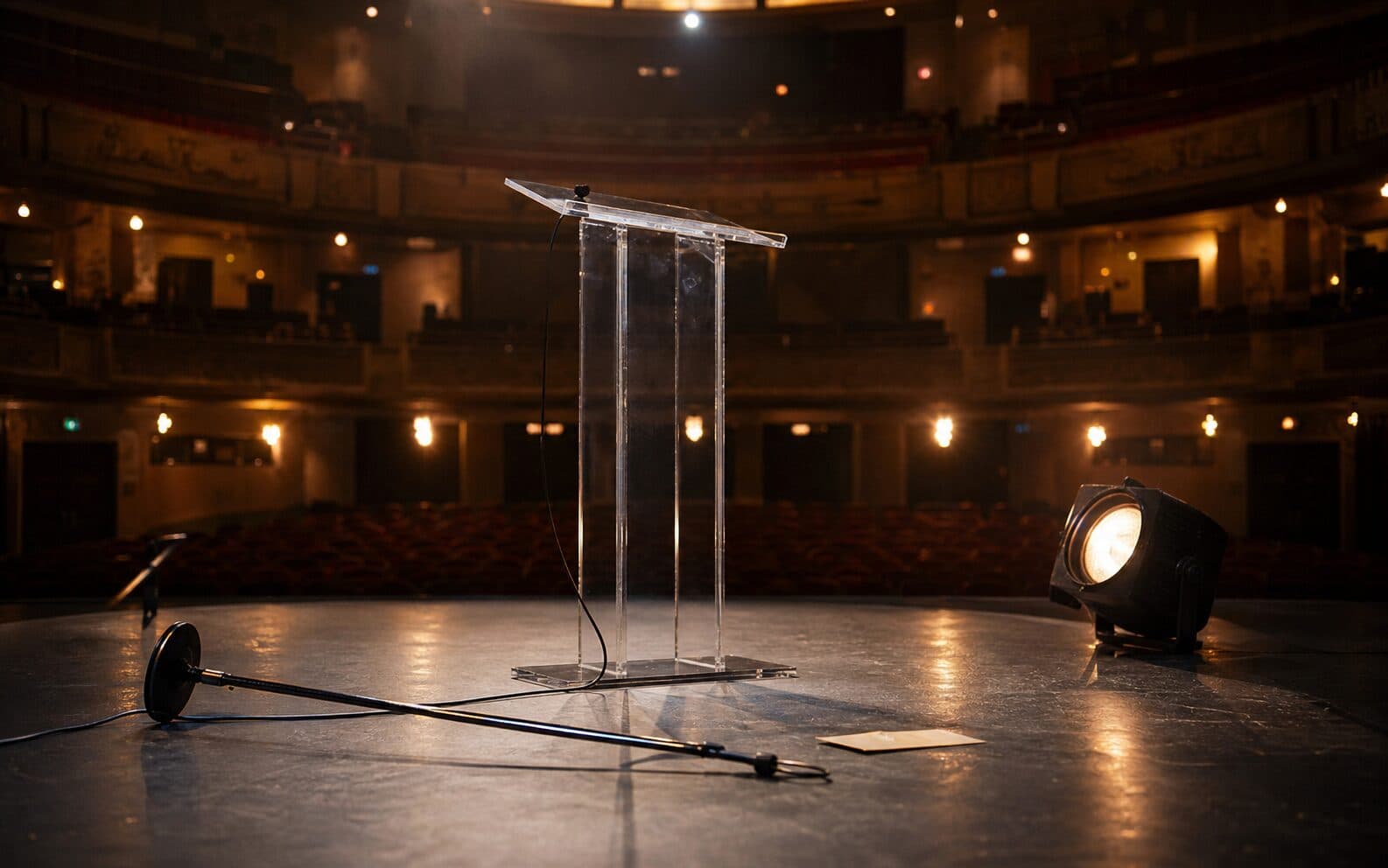
A live awards ceremony descended into prolonged public disagreement last night after an attendee walked onto the stage during another person's acceptance speech, took the microphone, and offered the audience an alternative view of who should have won.
Organisers say the evening had been proceeding to schedule. An award in a televised category had been announced, and the recipient — a first-time winner — had begun a short speech thanking those who had supported her. Witnesses report that the speech was still in progress when a second attendee left his seat, approached the podium, and was handed, or took, the microphone.
What followed was brief. The man informed the room that, in his assessment, a different nominee had produced superior work, before returning the microphone and leaving the stage. The recipient was left standing in silence. The ceremony continued, though several attendees described the remainder of the broadcast as "difficult to refocus."
By the following morning the incident had been replayed widely enough that commentators were no longer discussing the award itself. Discussion has since divided neatly into those who regard the interruption as honesty delivered at an unfortunate moment, and those who regard it as an unfortunate moment delivered as honesty.
The Interrupter's Account
I said what everyone was thinking, except apparently not everyone
The clip keeps circulating without the important context, which is that I had an opinion and access to a microphone.
I attended a major music ceremony where an award was given to someone the room was clearly pleased to see recognised. I was pleased too, broadly. I had no issue with her as a person.
The difficulty was that I held a strong and, I would say, well-founded view that a different nominee had made something more significant. The view arrived suddenly but with great force. Sincerity was never the issue.
So while she was speaking, I went up to share it.
I was quick. I said my piece, returned the microphone, and sat back down. I did not raise my voice beyond what the room required to hear me. The delivery was informative.
People are now saying I "took her moment." The moment was happening regardless. I added context to it. If anything, I broadened the conversation from one artist to two, which is more inclusive.
A few things I keep being asked, and my honest answers:
- Could I have waited until afterwards? Possibly. But the feeling was time-sensitive.
- Did she look upset? She looked surprised. I would not have characterised it as upset at the time.
- Did the crowd react? Yes. I took the reaction as engagement.
I genuinely believed I was speaking up for the work that deserved it. I still do. I am not sure why everyone keeps watching it back.
EDIT: I have since said sorry. I want that on the record too.
EDIT 2: People keep sending me the clip as though I have not seen it. I was there.
Ceremony Review
A useful principle in any shared environment is that the person currently holding the floor has been given it deliberately. Strength of feeling does not transfer that entitlement to anyone else in the room, however genuinely the feeling is held. The intensity of an opinion is not, in itself, a permission slip.
What we are looking at is a sequencing failure rather than a values failure. There was a perfectly legitimate channel for this feedback — voting, commentary, a later interview — and instead the input was delivered directly into the recipient's own milestone moment. You cannot insert your stakeholder note into someone else's announcement and expect the announcement to survive.
Industry reaction remains split between those who value spontaneity in the abstract and those who note that the spontaneity in question landed entirely on one person who had done nothing to invite it.
Transport Objection
Much has been made of the interruption, but I would observe that an event of this size has no dedicated rail link, leaving thousands of attendees dependent on road transfers. A scheduled departure board on the platform makes it very clear when it is and is not your turn. The principle of waiting for the correct service is one the industry settled long ago.
Audience Reaction
u/Podium_Etiquette_88 · 28702 points · 6h ago
There is genuinely no version of "I just wanted to be honest" that survives you walking onstage and removing the microphone from someone mid-sentence.
u/Quietly_Mortified · 17419 points · 6h ago
INFO: what part of "she is currently giving a speech" suggested it was a group discussion?
u/NominationCounter12 · 13104 points · 6h ago
"I broadened the conversation from one artist to two" is an incredible way to describe taking one person's award moment and making it about your opinion.
u/Reluctant_Witness_5 · 9044 points · 6h ago
The detail that gets me is "I took the reaction as engagement." Sir, that was a gasp.
Community Poll
Community Poll
Latest reader breakdown
Was interrupting the speech ever justifiable?
Update
The man involved has since issued an apology, which he has asked be noted.
I have said sorry, and I meant it.
I would only add that I still believe the other work was excellent, and that I do not think pointing that out was the wrong instinct, only perhaps the wrong minute.
Several observers noted that the apology arrived after the moment had already been lost, rather than before, and that the order of those two events is the entire disagreement.
Topics