Boardroom Fallout Follows Ill-Judged Brand Strategy Pitch
A commercial exercise intended to demonstrate leadership instead produced a sequence of avoidable errors, strained accountability, and one very public attempt to redefine failure as vision.
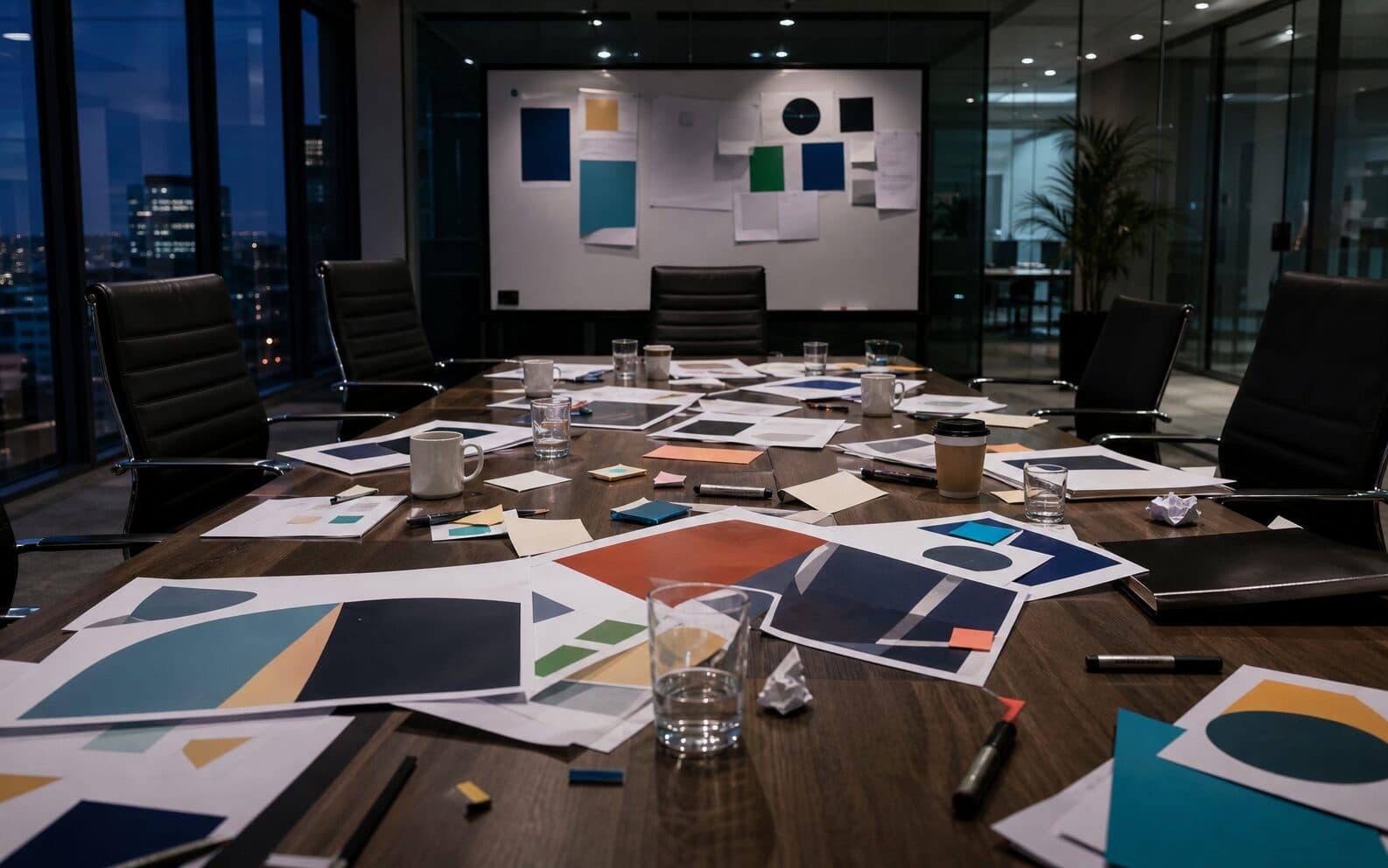
News Intro
A commercial exercise designed to assess leadership has concluded with the dismissal of the appointed team leader, after a branding project produced a finished product that several members of the public were unable to identify and a pitch that, by most accounts, made the situation worse.
The challenge was structured as a competition. Two teams were given the same brief, a fixed deadline, and a budget. Each was expected to develop a brand, manufacture a sample product, and present it to a panel of industry buyers. One team did this. The other team, observers say, spent a considerable proportion of the available time establishing who was in charge and what the product was.
The team leader maintains that the project was a success in all the ways that matter and a failure only in the ways that were measured. Buyers who attended the pitch reported that they left without a clear understanding of the product, its target market, or its name. The leader was subsequently removed from the project in a meeting described by participants as "frank."
The Leader's Account
How I led a branding task to a really strong outcome (long post)
Putting this down while the details are fresh, because there is already a lot of noise from people who were not leading the task.
I was made team leader after volunteering, which is usually how leadership reveals itself. The team needed direction from someone willing to make calls, and I made calls.
We read the brief. The brief said to create a brand and a product and present it to buyers. I felt the brief was, honestly, a little limiting, so early on I made the decision to focus on what I called the premium positioning. The team had questions about what the product actually was, but I explained that the product would emerge naturally once the brand was strong. I still think this was the right order of operations.
We did spend some time on the name. I won't say exactly how long, but I will say that a name is the foundation of a brand and you cannot rush a foundation. The name we landed on was tested informally on a member of the public who said it sounded like a cleaning product. We were making a snack. I noted the feedback and moved on, because you cannot design by committee.
The pitch is where people are being unfair. A buyer asked what the product was and there was a pause. I answered a different question because mine got closer to the brand truth. My teammate then gave a different price to the one I gave, in the same sentence as me. These things happen in a fast-moving commercial environment. A stronger buyer would have looked past them.
When we got back to the room, I was asked to account for the outcome. I explained that the other team had simply played it safe, and that real innovation is often uncomfortable. I was then informed that the other team had sold their product and we had not. I maintain that selling things is only one measure of a brand.
I was let go. I'd do almost all of it again.
EDIT: A few people are asking who chose the name. We chose it as a team, in the sense that I chose it and the team was present.
EDIT 2: The "cleaning product" comment was one person's opinion and I don't think it's fair to keep bringing it up.
Commercial Review
The fundamental error was sequencing. You do not build a brand and then locate the product underneath it later. The brand is meant to describe something that already exists. Here the team appears to have committed to a tone of voice before deciding what the tone of voice was for.
What's notable is how rarely anyone in the group said "I don't understand what we are making." In high-pressure teams, confidence is contagious and clarity is not. The leader projected certainty, so nobody felt able to admit confusion, and the confusion was therefore never resolved. It simply arrived at the pitch with everyone.
Industry observers note that the more revealing moment was not the failed pitch itself but the meeting afterwards, in which the leader's primary explanation for the loss was that the winning team had been insufficiently bold.
Infrastructure Objection
The premises used for this challenge have no direct rail connection, which I would suggest is the more pressing concern. A branding exercise can be repeated. A missed freight link of this kind tends to constrain a region for decades.
Buyer Reaction
u/Decisive_Under_Pressure · 31204 points · 6h ago
"The product would emerge naturally once the brand was strong" is the most expensive sentence I have ever read.
u/AsymmetricSnack · 22847 points · 6h ago
He answered a different question than the one the buyer asked because his answer was more important. I need to start doing this in my own life.
u/MildlyAlarmedTeapot · 15619 points · 6h ago
INFO: did anyone on the team ever find out what the product was, or did it remain a mystery to its own creators
u/QuarterlyRegret_88 · 9430 points · 6h ago
The other team sold their product and this guy's takeaway is that they "played it safe." Incredible. Genuinely incredible.
Community Poll
Community Poll
Latest reader breakdown
Did anyone in the room understand the brief?
Update
The leader has since clarified, in a follow-up statement, that the experience was "a learning opportunity for the people who fired me." Asked what they would change on reflection, they cited the lighting in the room and the attitude of one buyer.
Members of the winning team declined to comment, on the grounds that they were busy fulfilling their order.
Topics