I Left a Bowl of Sweets Outside With a Sign Saying “Please Take One.” At 6:43, I Saw What My Neighbour’s Son Did.
A teenager takes two packets from a Halloween bowl, then returns one after his sister gets sweets elsewhere. The homeowner turns the exchange into a question of wording, sequence, and exact counts.
News Intro
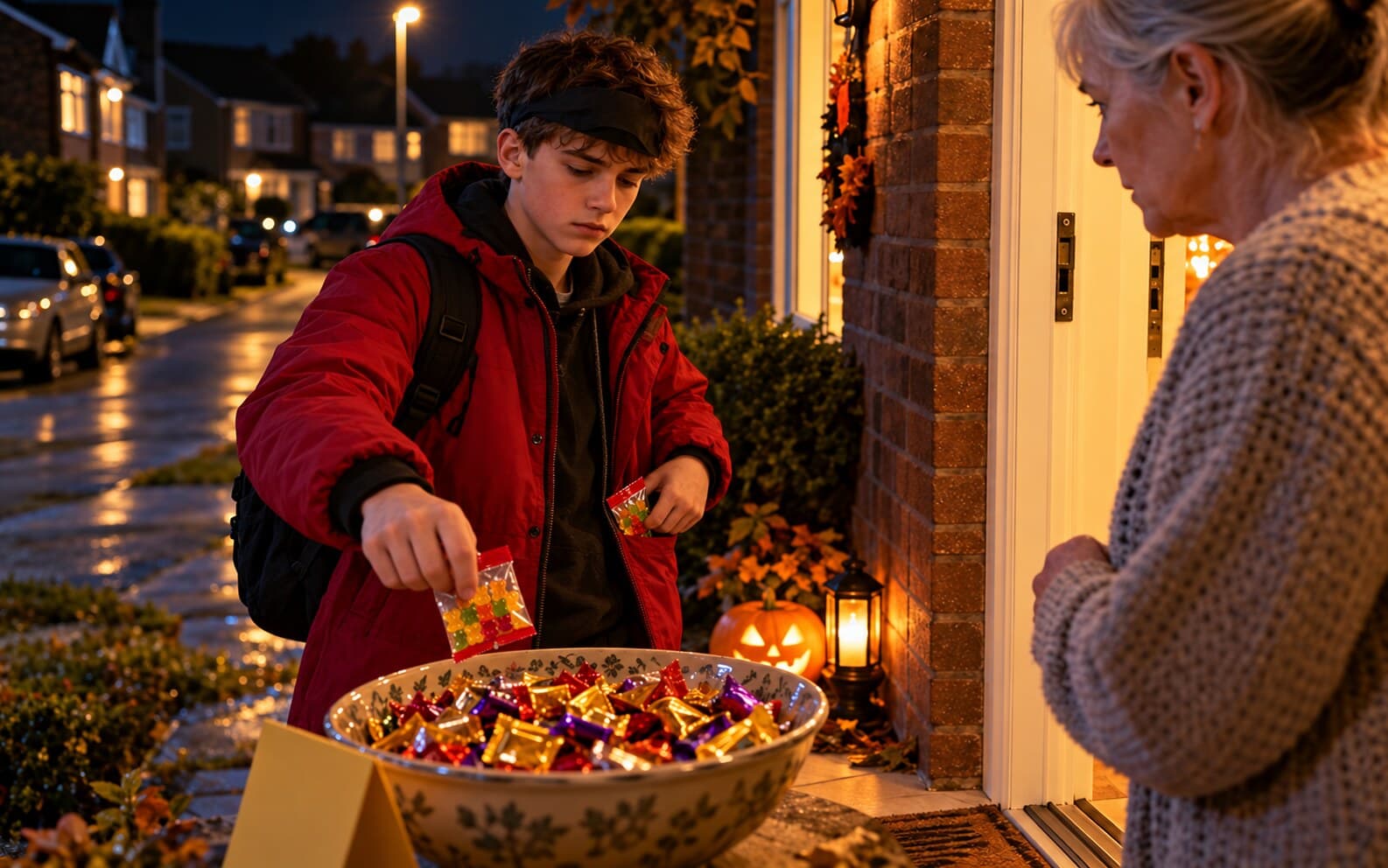
At 6:43 p.m. on Halloween 2022, Evan took two packets of Haribo from the bowl outside my front door.
He had read the sign first. PLEASE TAKE ONE. He was wearing the red coat he had worn for years, zipped to his chin, with his black cloth mask pushed up over his forehead. He put one packet in his pocket, glanced once toward the door, and walked down the path.
I was standing just inside the open door. I could have called his name while he was still on the path. I could have told him the instruction applied to both packets.
I did not call after him.
The bowl had contained thirty-six packets when I set it out earlier that evening.
The bowl
I had put a bowl outside for Halloween since 2018. I did it because there were years when the doorbell rang so often that I could not finish making tea without missing someone. A bowl let the children take one sweet while I opened the door for the next family.
The sign was written in black marker on a square of yellow card. PLEASE TAKE ONE. It was not an order. It was an instruction about how to share the bowl with the people who came after.
I used a ceramic bowl because it was heavy enough not to move when a child reached in. It sat on a narrow table under the porch light, beside the doorbell. The sweets were always individually wrapped. I checked the dates before I put them out and kept the spare packets inside, where they stayed dry.
The table stood thirty-two inches from the door and far enough from the step that a child could stop without blocking the path. I measured the distance once when I moved the table; after that, I knew where it belonged. The sign rested against the back of the bowl, angled toward the pavement. I did not attach it to the gate because people approached from both directions and needed to see it before they reached the sweets.
I filled the bowl after dinner, not before. If I filled it too early, the packets went soft in the damp air. If I waited until the first bell, I had to leave children at the door while I arranged them. There was a correct order: sign, bowl, porch light, then door. I followed it every Halloween.
My neighbour’s son, Evan, had come to our door every year since he was six. He was thirteen in 2022. He had grown taller than his mother and still wore the same red coat, though the sleeves stopped short of his wrists.
His mother, Rachel, was polite and often in a hurry. She worked evenings at the local pharmacy and walked Evan around the street before her shift started. Some years he came with his father. Some years with a friend. He always said thank you.
I had never needed to remind him of the sign.
In 2019, when Evan was ten, he came to the door in a cardboard shield and a plastic sword. He studied the bowl for a while, then asked whether the orange packets were sour. I told him I did not know. He chose one anyway and told his mother he would find out at home. She called back that he could have picked a different colour. He said he wanted to know.
The following year, I moved the table closer to the wall after a gust blew the sign onto the step. In 2020, I stopped putting the bowl outside for a while and handed sweets out from a tray inside the doorway. In 2021, I returned the bowl to its place beneath the porch light.
One packet
For years, the bowl had worked as intended. The sign was visible. Most children took one packet. If a child wanted to read a wrapper, the next child waited. If they changed their mind, they put the first packet back before taking another. I did not count the sweets before and after. I knew what I had put out, and I knew what remained when the evening ended.
In 2021, Evan came with two friends. They read the sign while they waited for Sophie to choose. Evan pointed at the words.
“What happens if you take two?” he asked.
His friend laughed. “You get two.”
Evan looked at me through the open doorway. “It doesn’t say what happens.”
“It says what to take,” I replied.
Rachel called them from the path. The three of them chose one packet each and went on. I did not add a second line to the card. “Please take one” was the instruction, and there was no space on the square for a paragraph about consequences. I did not think about the exchange again until the following Halloween.
At 5:30 on Halloween 2022, I filled the bowl with small packets of Haribo, wrapped chocolate fingers, and a few packets of jelly sweets without gelatine. I kept the different kinds in separate piles. It was easier for children to choose without having to touch everything.
There were thirty-six packets in all. I arranged the Haribo at the front, the chocolate fingers at the back, and the jelly sweets in a line beside the sign. I did not count them again after setting the bowl outside. The bowl was not a register. Its purpose was to make the choice available without asking each child for an answer in front of the group.
Before setting it outside, I moved the bowl to the edge of the table and checked the porch from the path. The sign was visible beside the doorbell. The porch light reached the whole table. I carried the spare box back inside and left the front door on its latch so I could hear the bell from the hall.
Rachel had once said she appreciated that I kept a few alternatives in the house. Sophie had been going through a phase of reading every wrapper, and she did not like to ask in front of other children. I placed suitable packets at the front of the bowl so she could choose without having to explain herself. I had arranged them by wrapper colour, then moved the green ones to the left after I noticed that the porch light made them difficult to distinguish from the black wrappers.
That was the purpose of the bowl: one packet in a child’s hand, and the next packet available to the child behind them.
At 6:12, the first family arrived. Their youngest child took a packet and brought it to his mother to check the ingredients. She read the label, nodded, and let him keep it. The next group rang the bell. I directed them to the bowl while I brought the spare box closer to the doorway.
At 6:28, a boy in a pirate hat picked up a chocolate finger, put it back, and selected Haribo instead. His father said he could take whichever one he wanted. At 6:35, two sisters came with their grandmother. One chose a green packet. The other chose a jelly sweet from the separate line. They left at the same time, each holding her own selection.
At 6:43, Evan came alone.
He had a red coat zipped to his chin and a black cloth mask pushed up over his forehead. The mask was part of his costume. He paused at the step and read the sign.
He took two packets.
He did not hurry. He glanced toward the door, then put one packet in his pocket and walked back down the path.
I could have opened the door.
I could have called his name.
I could have asked him to return the second packet while it was still in his hand.
I did not call after him.
7:26
At 7:26, I heard footsteps on the path again.
Evan stopped by the table. He looked through the open door. I was standing in the hall with a stack of paper bags.
“I took two earlier,” he said.
“I saw.”
He held out one packet. “Sophie already had one.”
“You took this for her?”
“I thought she might want it. She didn’t.”
“When did she get one?”
“At the next house.”
“Before or after you left here?”
He looked toward the pavement. “After.”
That explained the sequence. It did not alter it. Sophie had been given a packet elsewhere, after Evan had already taken one for her. He held the spare out to me because it was no longer needed.
I took the packet from him and checked the seal. It had not been opened.
“Is that all?” he asked.
I put it back in the bowl, in the space between the Haribo and the chocolate fingers.
“That’s all,” I said.
He nodded. He did not add anything to the explanation, and I did not request an additional statement. The packet had returned to the bowl; the reason concerned his sister. I kept those facts distinct.
He still had the first packet in his pocket. He left with it.
The interval was forty-three minutes. I knew this because I had seen him leave at 6:43 and heard him return at 7:26. I did not write the times down. I did not need to. The interval had established itself.
He had carried the packet around the corner, past the next house, and back again. It had not been opened. The wrapper was smooth except for one fold where his thumb had pressed against it. I placed it in the bowl with the folded edge facing down.
“Do you want another one?” I asked.
He looked at the bowl. “No. I’ve got one.”
“All right.”
He went home. I did not watch him to the corner this time. I returned to the doorway and put another paper bag on the stack. The next family was already waiting.
At 7:41, Rachel and Sophie passed the house. They did not stop. Evan was not with them. I continued handing sweets to the children who rang the bell. A girl in a paper crown asked whether she could take a green packet. I pointed to the front of the bowl. She chose one and went to catch up with her father.
At 7:53, a boy asked whether he could take one for his sister. I asked if she was with him.
“She’s at the gate.”
“Then she can choose one when she comes up.”
He went to get her. They returned together, and each selected a packet. I watched them leave with one in each hand. The sequence took less than a minute, but the bowl remained available to the next people who approached it.
I did not add a note to the sign. I did not need to. The written instruction and the arrangement of the packets were visible from the path. Anyone who came to the door could see how the bowl was meant to be used.
The returned packet stayed where I had placed it until another child took it. I saw that happen. There was no announcement and no exchange of names. The packet went from the bowl to a small hand and then down the path.
By 8:10, the bowl was nearly empty. I carried it inside and put the sign in the kitchen drawer. I did not throw it away. The next Halloween would require another sign, and the wording would need to be exact.
I put the remaining packets in the pantry and counted them while I was there. There were four. I had counted thirty-six at the beginning, so thirty-two were no longer in the bowl. I had not recorded who took each one.
The sign went into the drawer face up. The words were still legible beneath the porch light, and the fold had not split. I put the marker beside it so I would not have to search for one the following year.
The following Halloween
In 2023, I made the sign again. The old card had a crease across the word “one”. I used a fresh square of yellow card and wrote PLEASE TAKE ONE PACKET in black marker. The additional word identified the unit being taken. It was a small amendment, but the instruction now contained the noun that the arrangement had relied on all along.
I put the bowl on the same table. The ceramic one had a small chip along its rim, so I used the wider glass bowl from the kitchen cupboard. I arranged the packets in three groups: Haribo, chocolate fingers, and the jelly sweets Sophie could have. The sign stood behind them, centred between the doorbell and the porch light.
I set the bowl out at 5:30. At 5:42, I checked the sign from the pavement. At 5:47, I moved it half an inch to the left so it would not cover the doorbell. At 5:49, I checked it again from the step. The wording could be read from either direction, and the bowl did not obscure the final word. At 6:12, the first family arrived. They read the sign before they reached for the sweets.
At 6:43, Evan arrived with Sophie. He wore the same red coat. Sophie read the sign aloud while she looked into the bowl.
“Can I take a green one?” she asked.
“Yes,” I said.
She chose a packet. Evan waited, then picked one for himself. They thanked me and went down the path. I watched until they had reached the pavement. Neither packet had been returned to the bowl, and neither needed to be.
I did not ask whether he remembered the previous year. He did not mention it. The bowl held two packets fewer, as it should have. I stood by the door until the next family came up the path.
At 7:18, a child asked me to read the sign aloud. I did. She looked at the bowl, then at her father, and took one packet. Her father thanked me. I watched them go as far as the pavement before opening the door for the next group. She had heard the instruction, confirmed it, and acted. It was a complete exchange.
The sign remained in place until the last family had gone. No one moved it, and no one asked what it meant. I brought the bowl inside at 8:06 and put the remaining sweets away. I kept the card on the counter while I washed the bowl, then dried it and put it back in the cupboard.
The following morning, I put the new card in the kitchen drawer, behind the previous sign.
I kept the two cards together. I did not label the drawer. The difference was visible without one.
Topics