My Husband Moved My Halloween Pumpkin Three Feet. He Didn't Know What That Spot Meant to Me.
A pumpkin moved three feet from its usual place turns into a defining dispute about family respect, an unspoken Halloween tradition and who gets to decide where things belong.
News Intro
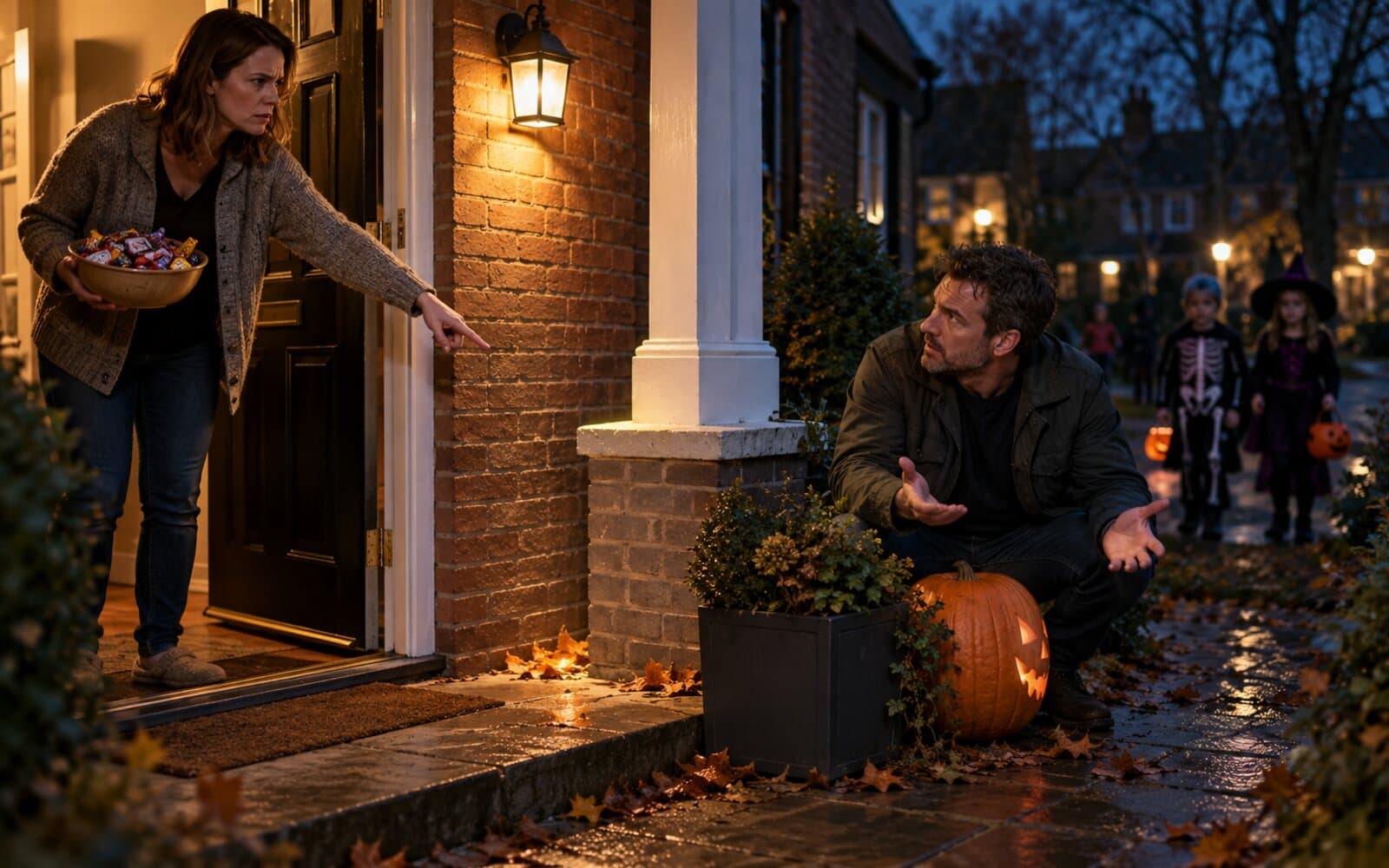
At 6:12 p.m. on Halloween, my husband moved the pumpkin three feet to the left.
He did not ask me.
He did not look at the porch before he moved it. He lifted it by the sides, carried it across the paving, and set it down beside the planter where we kept the recycling box during the week.
Then he turned the carved face toward the wall.
“The courier needed the step clear,” he said.
The courier had left nine minutes earlier.
For thirteen consecutive Halloweens, the pumpkin had occupied the same place beside the right-hand porch post. In 2025, for the fourteenth time, I had set it there myself.
At 6:12, Andrew moved it.
I was standing in the hall with a bowl of sweets in my hands. I could see the porch through the glass in the front door. The pumpkin was still lit from within, its crooked smile turned away from the street.
“Why did you move it?” I asked.
“It was in the way.”
“It was in its place.”
He looked at me, then at the pumpkin. “It’s three feet away.”
“That is not the distance I asked about.”
He did not answer. I set the bowl on the hall table and opened the door.
The place beside the post
We moved into the house in 2012. Our daughter, Emily, was five. The first Halloween, she came home from school with a picture of a pumpkin she wanted us to carve. It had one square eye, one round eye, and a mouth with too many teeth.
Andrew bought a pumpkin after work. We carved it at the kitchen table, where the newspaper had been spread over the surface and Emily had been given a spoon she could hold with both hands. She removed the seeds. I drew the face. Andrew cut it out.
When we carried it outside, Emily chose the space beside the right-hand porch post.
“That’s where the light reaches it,” she said.
The porch light was on a timer then. It came on at 5:45, just before the first children usually reached our street. The light fell across the step and the pumpkin’s face looked different from the pavement than it did from inside the house. Emily stood at the gate and checked.
“People can see it from there,” she said.
We left it in that spot.
The next year, Emily asked if we could put the pumpkin beside the post again. I said yes. In 2014, she drew the face herself. The years after that brought different faces: one with a long nose, one with a gap where a tooth should have been, one that Andrew called “the serious one” because the mouth was nearly straight.
The pumpkin changed. The place did not.
From 2012 through 2024, we put it beside the same post every Halloween. Some years Emily helped carve it. Some years she was out with friends and sent a picture of the one we had made. The porch light was replaced in 2018, but the new one fell at the same angle. The paving was relaid in 2021. We kept the post, the light and the pumpkin’s position.
No one had written this down. There was no rule in the house. There did not need to be. The place was part of the evening in the same way the sweets bowl was part of the evening and the doorbell was part of the evening. We knew where each thing belonged.
When Emily started secondary school, she stopped carving with us every year. She still asked to see the pumpkin. When she began sixth form, she took over the sweets bowl and answered the door while I watched the step. By then, the pumpkin was no longer a child’s project. It was ours.
There were Halloweens when the weather made the position more difficult. In 2016, rain came in from the road and I had to angle the pumpkin away from the downpipe. In 2019, a gust caught the paper decorations Emily had tied to the rail. In 2021, the builders left the path uneven for three weeks, so I moved the pumpkin inward by the width of a paving slab while the work was under way. I put it back when the paving was finished.
Andrew had been home for each of those evenings. He knew the difference between a temporary adjustment and changing the place. He had helped me carry it inside when the wind became too strong. He had wiped the rain from its face and put the light back in. None of that required a discussion because we both understood what we were preserving.
That history did not make me expect praise. It made me expect the same ordinary consideration we gave the sweets bowl, the door key, and the things we had already agreed belonged where they were.
Andrew had never questioned the position before.
This is why I did not think I needed to explain it to him.
Halloween 2025
On Friday 31 October 2025, I bought the pumpkin at the greengrocer on my way home. It weighed just over eight pounds and had a pale patch on one side. I chose it because the stem curved toward the street, which made the face look as though it was leaning forward to greet someone.
At 4:38, I put it on the kitchen counter.
Emily was eighteen by then and had gone to university in September. She was staying in her room that evening because she had an early train the next morning. She did not carve the pumpkin, but she came downstairs to look at it while I was sketching the eyes.
“That one will show from the gate,” she said.
“That’s what I thought.”
Andrew was in the dining room, assembling the narrow hall cabinet he had brought home in two flat boxes the previous afternoon. One drawer front had arrived damaged, and the retailer had arranged a replacement delivery for the early evening. Most of the cabinet was already assembled; he was waiting for the replacement panel before fitting the last drawer.
“They’ll leave it on the step,” I said.
“They’ll need to get it through the door,” he replied.
“We can bring the pumpkin inside for five minutes.”
“Let’s see what they do.”
I finished carving at 5:26. I cleaned the edge of the mouth with a small paring knife, wiped the outside, and put a battery light inside. We had stopped using a candle after the year the wind blew the flame out before the first trick-or-treaters arrived.
At 5:43, I carried it outside. I set it on the paving beside the right-hand post, with the stem angled toward the gate. I stepped back to the pavement and checked the face from the place Emily had stood in 2012.
It was visible.
At 5:45, the porch light came on.
Andrew was still at the dining table. He had the cabinet instructions open and one side panel balanced against the chair. He looked up when I came in.
“It’s in place,” I said.
“Good.”
At 5:58, the courier rang the bell with the replacement drawer front in a long, flat box. Andrew came to the hall while I opened the door. The box was too wide to carry through without turning it onto its narrow side. He and the courier lifted it together, angled it past the door frame, and took it into the dining room.
The pumpkin remained beside the post.
The courier was gone by 6:03.
At 6:12, Andrew went back outside. I assumed he was collecting the empty cardboard from the path. When I looked through the glass, he was carrying the pumpkin.
“What are you doing?” I asked.
“Moving it out of the way.”
“The delivery is finished.”
“I need to get the cabinet parts in and out.”
“They’re inside.”
He placed the pumpkin beside the planter. Its face was now directed toward the brick wall. The porch light left one eye in shadow.
I opened the door. “Put it back.”
He looked at the cabinet box inside. “I’m still working here.”
“The pumpkin is not in the way.”
“It was where I needed to walk.”
“You have already carried the cabinet through.”
“I’ll be moving the pieces around.”
I held the door open. The bowl of sweets sat on the hall table behind me. A group of children were already coming up the path next door. One of them had a cardboard crown that kept slipping over his eyes.
Andrew lowered his voice. “I only moved it for a little while.”
“You moved it without asking.”
“It’s a pumpkin.”
“It is our Halloween pumpkin.”
He looked past me toward the children. “I’ll put it back after I finish.”
I let go of the door handle. “You have finished moving the cabinet.”
He went back inside.
A question of position
At 6:19, the doorbell rang. I handed out sweets. A girl in a witch’s hat looked toward the planter.
“Where did the pumpkin go?” she asked.
“It’s there,” I said.
She turned her head, saw it facing the wall, and looked back at me. “Oh.”
She took one sweet and went down the path.
I did not make an entry of the exchange. I did not need to. I had heard what she said, and I knew what the answer had been.
Andrew continued assembling the cabinet. He laid its doors against the wall, checked the hinges, and returned twice to the hallway for a screwdriver. Each time, he passed the pumpkin. Each time, he could have put it back.
At 6:31, Emily came down to the hall. She was wearing her coat and had her train ticket open on her phone.
“What happened to the pumpkin?” she asked.
I looked at Andrew, who was carrying a shelf panel through the dining room.
“It needed to be moved,” he said.
Emily looked at the empty space beside the post, then at the pumpkin by the planter.
“It doesn’t look right there.”
Andrew set the panel down. “It’s still on the porch.”
“That isn’t where it goes,” Emily said.
He rubbed his thumb along the edge of the panel. “I’ll put it back when I’m done.”
Emily looked at me. I did not ask her to say anything else. She did not need to defend the place. She had chosen it when she was five, and for thirteen years we had kept it there. The fact that she could say it plainly was enough.
At 6:44, she left to meet a friend at the end of the road. She stopped at the gate and turned back once, looking at the porch.
My neighbour, Mr Patel, came over at 6:52 with his grandson. He paused at the gate, looked at the pumpkin beside the planter, and then at the empty place by the post. He did not ask what had happened. He gave me a small nod and guided the boy toward the door.
I knew he had noticed the difference. For years, he had waved to Emily while she set the pumpkin down. In 2018, he had lent us a longer extension lead when the porch light failed. He knew the position was not accidental. He was not taking sides; he was acknowledging a detail that had been present for most of the time we had lived on the street.
Andrew saw them leave. He did not say anything. The children came and went, and the pumpkin continued to face the wall. I kept answering the door because that was still my responsibility. I did not let his decision interrupt the evening for anyone else. That did not make the decision less deliberate.
The children continued to arrive. Some came in pairs, some with a parent waiting at the pavement. I gave each group one or two sweets, depending on the size of the group. The bowl was almost half empty by seven.
The pumpkin stayed beside the planter.
At 7:06, Andrew finished the cabinet. He wiped the packaging dust from the dining table and stacked the instructions on top of the cardboard. He went to the kitchen to wash his hands.
I was at the door with a boy who had come dressed as a skeleton. He had a plastic bucket with a handle that had been repaired with tape.
“Your pumpkin’s looking at the wall,” he said.
“I know.”
He considered that. “Is it supposed to?”
“No.”
He nodded as if I had answered a reasonable question, took a sweet, and left.
When I closed the door, Andrew was standing in the hall. He had heard us.
“I said I’d put it back.”
“You said after you finished.”
“I finished.”
“Then put it back.”
He did not move. “I don’t understand why the exact spot matters this much.”
“You don’t have to understand what it means to leave it where we put it.”
He looked at the pumpkin. “You could have said something before.”
“I did.”
The next group rang the bell. I opened the door before he answered.
The return
At 7:22, Andrew brought the pumpkin back to the step.
He lifted it with both hands and set it down beside the right-hand post. The base landed on the faint pale circle left by last year’s pumpkin. He turned the stem toward the gate, checked the carved face from the pavement, and made one small adjustment.
The porch light reached both eyes.
He stood back. “Here?”
“Yes.”
He nodded. “I should have asked.”
I accepted that. I did not tell him that the apology mattered more than the pumpkin. The pumpkin was in the right place. The apology belonged beside it.
At 7:34, a woman came up the path with two children. One of them stopped at the gate and looked at the pumpkin.
“That’s the one,” she said to her brother.
She did not know our history. She did not know who chose the place or how many Halloweens it had held. She only recognised that the pumpkin was where it belonged.
Andrew was behind me in the hall. He heard her.
The bowl was nearly empty. We had another bag in the cupboard, but I did not open it. The evening was moving toward its close, and the remaining sweets were enough for the children still on the street.
Emily returned at 8:11. She looked at the step before she took off her coat.
“It’s back,” she said.
“Yes.”
She glanced at Andrew. “Good.”
He did not defend the move. He did not explain the delivery again. He picked up the empty bowl and took it to the kitchen.
That was the part I remembered: not the argument, but the fact that he carried the bowl away while the pumpkin stayed where Emily had put it thirteen years earlier.
We did not make a new rule. We did not hold a conversation about household authority. The next day, the pumpkin was soft enough to clear from the step. Andrew lifted it from beside the post and put it in the food waste bin.
The place remained.
For thirteen Halloweens, it had been understood without being stated. In the fourteenth year, it was moved and returned. I do not regard those as equal actions. One was done without thought. The other required him to look at the step, see the empty place, and put the pumpkin back where he had found it.
Topics