My Neighbour Took Over Our Bonfire Night Display. Then He Used the Grand Finale First.
After twelve years arranging a small family Bonfire Night display, Adrian lets his neighbour take over. The brightest fountain is used first, leaving the evening without its intended finale.
News Intro
The final fountain lasted eleven seconds.
It was the first thing Chris lit.
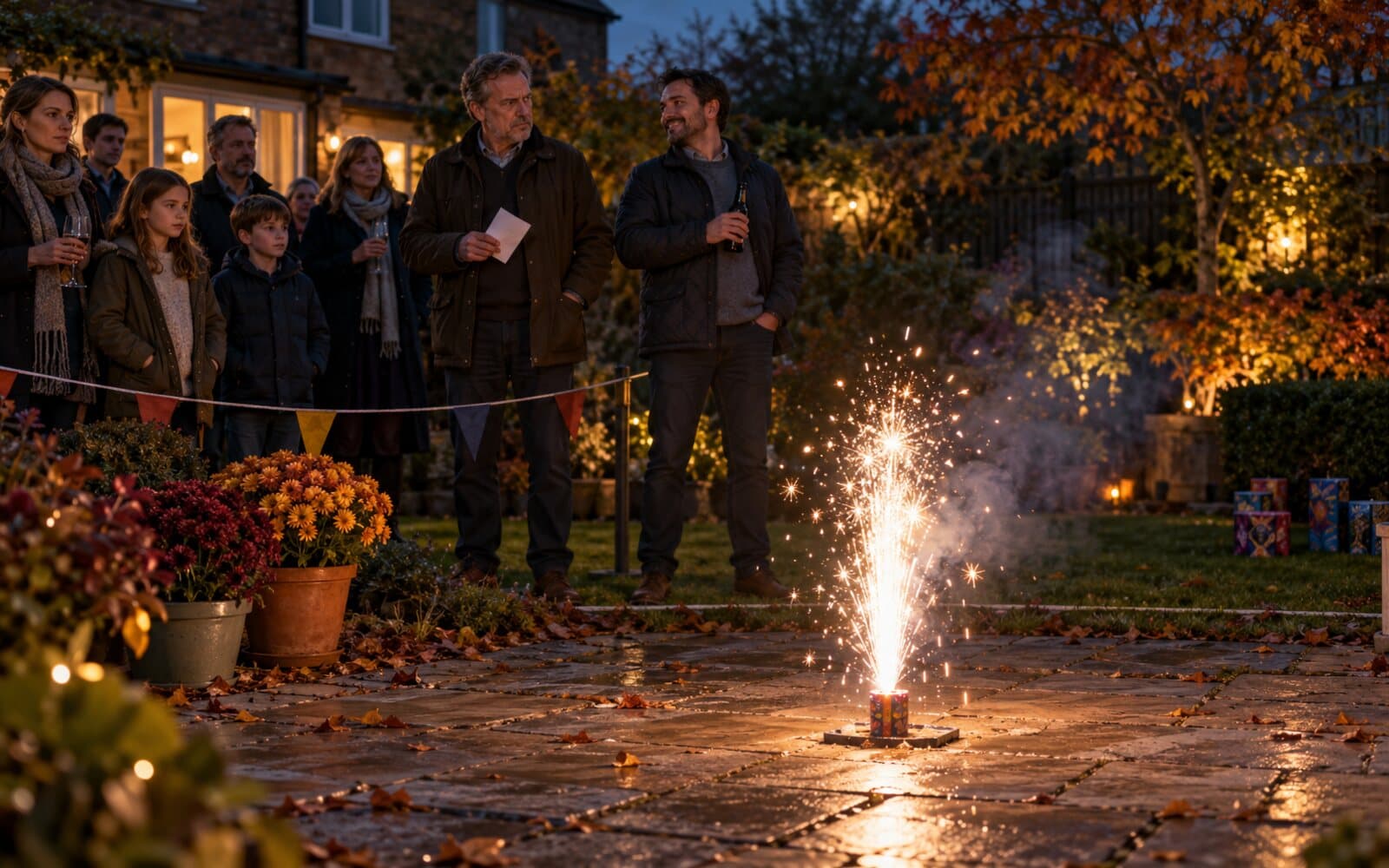
At 6:21 p.m. on 5 November 2025, I watched the brightest firework in our Bonfire Night display burn out before the first of the smaller pieces had been used. The children were still standing behind the line. The hot chocolate was still in the kitchen. The last item in the running order had been used before the evening had begun.
Chris turned to me.
“That was the best one.”
“It was the final one.”
He looked at the empty stand. “It’s the same thing.”
It was not.
For twelve years, I had arranged the order of our small Bonfire Night display. In 2025, I let my neighbour take over.
He used the grand finale first.
The order of things
Our first Bonfire Night at the house was in 2013. Our daughter, Lucy, was seven. The back garden was small, but the previous owners had left a level paved area at the far end beside the shed. I checked the space, asked the neighbours, and set up a modest display using a small selection of commercially packaged fireworks. We followed the instructions, kept everyone at the agreed distance, and let the adults handle the display.
The order was simple. We started with a quiet fountain, let the children settle into the sound, then moved to two brighter pieces. We ended with the largest fountain in the pack.
That last fountain was not large by public-display standards. It was not meant to be. It rose to just above the fence and held for eleven seconds. But it made a proper ending. The children knew when to look up. The adults stopped talking. When the sparks went out, the evening had reached its conclusion.
That was the point.
Over the next few years, other families on the close began joining us. Two neighbours brought soup one year. Someone else supplied paper cups. Chris moved in next door in 2017 and came over with his wife and their two sons. He was generous with his time and quick to volunteer. He could also mistake enthusiasm for authority.
In 2018, he suggested starting with the big fountain.
“It’ll get everyone’s attention,” he said.
“It’ll also be over before we’ve started,” I replied.
He laughed. I did not.
He accepted the running order after that. Each year, he helped carry chairs or bring the drinks inside. I arranged the sequence. Nobody had objected to it. People came back the next year.
In 2021, a neighbour asked whether we could leave a longer pause before the final fountain because her youngest was nervous about the noise. We did. In 2022, Lucy asked me to put the quieter piece first because her cousin had never seen fireworks before. I changed the order and told everyone why. In 2023, the wind shifted, and I moved the viewing group farther from the display before we started. The sequence was not sacred because it could never change. It mattered because changes were made deliberately, with the people there in mind.
Chris had been present for each of those evenings. He had watched me adapt the plan when someone needed it. That was why his suggestion in 2025 sounded reasonable. He was not a stranger trying to take control of a gathering. He was the neighbour who had carried the chairs and remembered who needed a warm drink.
But helping with the display had never meant deciding that its last moment could be spent at the beginning. He knew there was an order. I had told him. The card made it plain. His confidence rested on the assumption that if people enjoyed the brightest item, it did not matter when they saw it.
That assumption did not belong to him alone. It belonged to the kind of person who thinks an ending is only a position on a list, and that a list can be rearranged without changing what it means.
By 2024, we had held twelve displays. The set-up was familiar. I checked the forecast, confirmed with the neighbours, and put the items in order before anyone arrived. The display itself lasted less than ten minutes. The preparation took longer, because the order was the preparation.
I never called it a tradition. I did not need to give it a name. It had continued from year to year, and everyone knew when the final fountain would be lit.
The first item was deliberately modest. It gave people time to find their place and let the children adjust to the noise. The second held their attention. The middle piece lifted the pace. Then there was a pause long enough for people to wonder if the display was finished.
It was not finished.
The final fountain answered that question.
There is a difference between the last thing in a box and the thing that ends an evening. I had understood that from the first year. I assumed everyone else did too.
A change of hands
On 5 November 2025, the weather was clear and cold. At 4:30 p.m., I carried the chairs to the paved area. At 5:05, I placed the drinks on the kitchen counter and checked that the back gate was closed. At 5:18, Chris came through the side entrance carrying a pair of gloves.
“You’ve done this for twelve years,” he said. “Let me run it tonight. You can watch with everyone else for once.”
I had a sore knee. It was not serious, but I had been asked twice that week whether I was going to be on my feet all evening. Chris was offering help, and there was no reason I could not accept it.
“The order matters,” I said.
“I know.”
“The fountain is last.”
“I know, Adrian.”
He said my name with a smile that suggested he had already agreed and wanted to move on. I took that as agreement.
I handed him the running order. It was a plain card with four numbered lines. The first three were the smaller pieces. The last line said Final fountain — end of display. I had written it clearly. He glanced at the card and folded it once before putting it in his coat pocket.
“You can keep that in front of you,” I said.
“I’ve got it.”
At 5:42, the neighbours began to arrive. I stood with Margaret near the back step. Lucy was home from university for the weekend and had taken a position beside her younger cousin. Chris moved around the garden greeting people and answering questions. He looked comfortable. I was glad he had volunteered.
At 6:21, the children were behind the marked line. The adults were standing with them. Chris checked that everyone was ready. He had the items in their original packaging and the instructions beside him. There was nothing improvised about the set-up.
“We’re starting,” he called.
I saw him look at the final fountain.
“That’s last,” I said.
He paused with it in his hand.
“I thought we’d start with the best one,” he said. “Get the big reaction while everyone’s here.”
“It is the finale.”
“It’s just a fountain.”
“It is the final fountain.”
He looked toward the guests. “They’re ready.”
I could have taken the item from him. I did not. The guests were in position, the area was clear, and Chris had offered to run the display. I had no reason to create a second confrontation before the first item had been used.
I said, “Then follow the order.”
He did not.
Margaret was standing close enough to hear. She did not step between us. She looked at the card in Chris’s pocket, then at me, and gave a small, apologetic lift of her eyebrows. She had understood what I was asking. She had also understood that Chris was not going to stop with everyone waiting.
I returned to the group. One of the children asked if the first one was the finale. I said it had been intended for the end. The child nodded and went back to watching Chris. No one asked me to intervene. No one asked him to put it away. They were waiting for the display to begin, and that was the point he used to justify the decision.
There are moments when a person is given a clear choice and still decides that the explanation is optional. I had given him the order. I had repeated it. I had handed him the card. I had said the fountain was last while he was holding it. What happened next was not a misunderstanding.
Eleven seconds
The fountain began with a low hiss. A white spray rose above the stand, then widened into a gold fan. It was the brightest part of the display. The children shouted. One of the neighbours clapped before it had finished.
Eleven seconds later, it went dark.
Chris turned around smiling. “That got their attention.”
I looked at the card folded in his pocket.
“That was the finale,” I said.
“We’ve still got the others.”
“The others were meant to lead to it.”
He turned back to the stand. “Well, they’ll have to lead to something else now.”
No one else heard that exchange. They were talking about how bright it had been. A child asked if there was another one like it. Margaret said the hot chocolate was ready inside.
The display continued.
The next fountain was smaller. It did what it was supposed to do. People watched. The children stayed behind the line. There were no problems with the fireworks, and nobody was in danger. The only thing that had gone wrong was the order.
That was enough.
The next item made a short, even spray. The children clapped when it ended, because they had been told there would be several pieces and they were watching each one. Chris checked the card again. He had to unfold it fully this time. The crease ran through the words on the final line, but they were still readable.
“This one next?” he asked.
“Yes.”
He looked toward the stand. “And then the other one?”
“Then the other one.”
He gave a quick nod, as though we had settled an ordinary matter. I watched him place the next item. The display was proceeding in sequence again, but sequence restored after the fact could not restore the moment we had already spent.
Margaret brought the hot chocolate out while we waited. The cups were warm through the paper sleeves. Lucy asked whether the last one had been used. I said yes. She looked past me at the empty spot beside the remaining items.
“Already?” she said.
“Chris wanted it first.”
She looked at him, then back at me. She did not argue. She took her drink and stood beside her cousin.
That was the first time I understood that the order had not only been mine to remember. Other people had been waiting for the end. They had trusted that the evening would arrive there in the way it always had.
After the second item, Chris looked at the card. He had unfolded it and was holding it in the light from the kitchen window.
“This says final fountain at the end,” I said.
“I can read it.”
“Then why did you light it first?”
He put the card back in his pocket. “Because everyone was ready.”
“They were ready for the first one.”
“They liked it.”
“They liked the fountain.”
“Exactly.”
I looked past him. The children were still watching. One was holding a cup in both hands. Another was asking his mother whether the next one was the last.
“The order is the part that tells them what to expect,” I said.
Chris gave a short laugh. “It’s five minutes in a garden.”
“It is our display.”
He did not answer. He picked up the next item.
We used the remaining pieces in the order they had been planned, except that the final fountain was gone. The third rose higher than the second. The fourth lasted longer. They were good fireworks. Each one performed as intended.
But the audience had already seen the ending.
When the fourth item finished, there was a pause. People waited. Chris looked at the stand. I looked at the empty place where the final fountain should have been.
Someone at the back asked, “Is that it?”
“That’s it,” Chris said.
The children began to move toward the drinks. The adults started talking about the cold. The display ended because there was nothing left to light.
What came after
Chris carried the empty packaging to the bin. I collected the card from the ground where it had slipped out of his coat. The fold ran directly through the last line.
Margaret asked if I was all right.
“The display was out of sequence,” I said.
She looked at the children, who were now comparing the sparkles they had seen. “They liked the big one.”
“That is why it should have been last.”
She held out a cup of hot chocolate. I took it.
Chris came over a few minutes later. “I didn’t mean to spoil it.”
“You didn’t spoil the fireworks.”
“It was a good one to start with.”
“It was the ending.”
He looked toward the stand, now empty. “I thought the order was flexible.”
“You asked to run it. I gave you the order.”
He nodded, but he did not apologise again. I did not ask him to. An apology would not put the fountain back in its place. The evening had already ended the way it ended.
The children were still talking about the display when they went home. Chris’s sons said their favourite had been the first fountain. I heard them. I did not correct them. They were entitled to like the firework. That was not the question.
The question was whether the display had ended where it was meant to end.
For twelve years, the final fountain had been the last thing people saw. In 2025, they saw it first. The distinction remained, whether or not anyone else thought it needed explaining.
The next morning, Chris sent a message: Thanks for hosting. The boys said the first fountain was the best one.
I replied, I’m glad they enjoyed the display.
I did not mention the running order. The children had enjoyed the first fountain. I had seen that. Their enjoyment did not alter the position it had occupied in the sequence.
People asked whether the fireworks had gone well. I said they had all worked as intended. That was accurate. It was not the same as saying the display had gone well.
There is no way to return a finale to the moment it was supposed to finish. Once it has been used, all that remains is the order in which it happened. I had arranged it for twelve years. In 2025, I watched it happen in the wrong order and let the evening end there.
Topics