My Sister-in-Law Told Me Not to Bring Gravy to Thanksgiving. At 4:17 PM, My Father-in-Law Asked One Question That Silenced the Table.
After eleven years of refining the family Thanksgiving gravy, Claire was told not to bring it and watched instant granules take its place.
News Intro
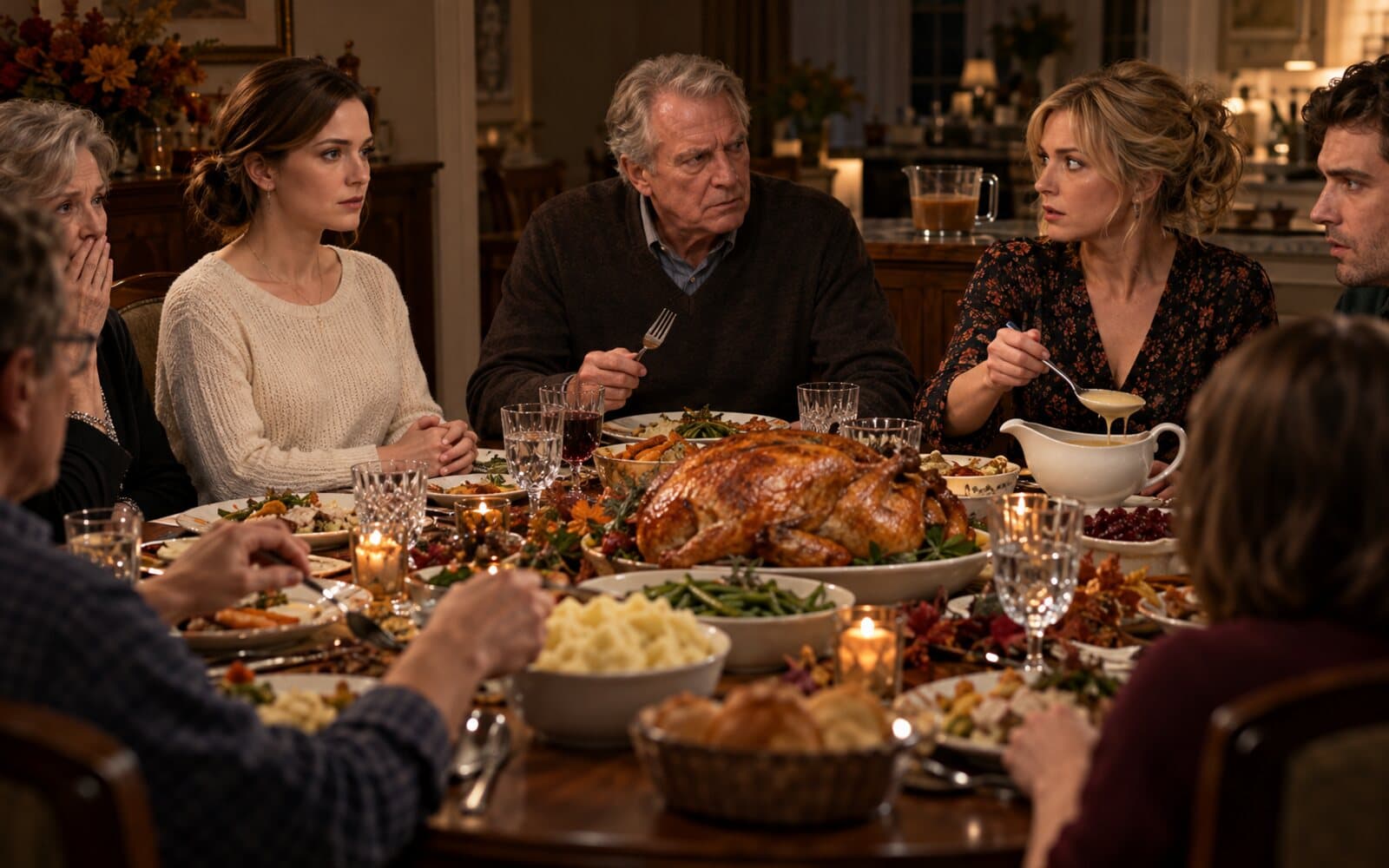
At 4:17 p.m., George put down his fork.
The room had been loud a moment earlier. Somebody was asking for the potatoes. A chair scraped against the floor. Beth was explaining why she had chosen the instant granules instead of “making a production” out of the gravy.
George looked at the gravy boat in front of him. Then he looked at me.
“Who told Claire not to bring the gravy?”
No one spoke.
Beth stopped with the serving spoon halfway between the bowl and her plate.
I sat with my hands folded in my lap. I had not brought gravy. I had been told not to.
For eleven years, I had made the family Thanksgiving gravy. For eleven years, I had kept a record of every complaint, adjustment, and requested change. The record had 11 annual sections, 63 entries, and a final recipe that accounted for the weight of the turkey, the pan dimensions, the stock volume, and the resting time before the drippings were strained.
Beth had told me not to bring it.
At 4:17, George wanted to know why.
Eleven Years at the Stove
I first made the gravy in 2015, the year David and I hosted Thanksgiving in our narrow kitchen on Wexler Street. The turkey was larger than the roasting pan, the oven ran hot on the left, and the gravy thickened while I was trying to find the carving knife.
It was not the gravy I would serve today.
That evening, George said it was “a little heavy.” My mother-in-law, Jean, said it needed more pepper. David said nothing until the next morning, when he used the last of it on toast.
I wrote down all three observations.
The next year, I began again with a notebook. I wrote down the turkey weight, the volume of drippings, how long the pan sat before I deglazed it, and whether I had used stock from the carton or the batch I had made in advance.
The family comments went in a separate column.
“Too thin,” from Beth in 2016.
“Better, but still salty,” from her husband, Mark, in 2017.
“Could we have more?” from George in 2018.
I kept the wording exact. “Could we have more?” was not the same as “There was not enough.” I would not distort a record in order to make a point.
By 2019, I had converted the notebook into a spreadsheet. It had columns for date, bird weight, pan size, stock volume, flour quantity, simmer time, consistency, and comments. I added a page for equipment because the roasting pan changed when Jean replaced hers.
The family did not know about the spreadsheet. They did not need to. I was refining a recipe that everyone ate every year, and I wanted each change to be traceable to its result.
In 2018, I added a separate field for comments made before the first serving and comments made after the second. George’s “Could we have more?” had come after his second serving, which changed its meaning. Beth’s “too thin” had been said before she tasted it. I did not treat those observations as equivalent.
In 2020, I began logging the time the turkey left the oven and the time the gravy reached the table. The gap between them affected the drippings. In 2021, I recorded the temperature of the stock when it entered the pan. In 2022, I noted that the gravy boat had been warmed for six minutes, not the ten I had requested. Each detail had a place because each detail could affect what followed.
The 2023 comments were the first set I entered directly from my phone. I transcribed them into the spreadsheet that night and matched each one to the date. I did not rely on anyone’s later recollection of what they had said.
By the time Beth asked me to bring the gravy again in 2024, the process had a stable sequence. I kept the current recipe in the family kitchen drawer and a backup copy in my own recipe binder. Nobody had asked to see the binder. That was not its purpose.
In 2020, Thanksgiving moved to David’s parents’ house because Jean had recently had her kitchen repainted. I brought the gravy in a sealed container and finished it on the stove. The stock had been measured to the millilitre. The flour had been sifted twice. George asked for a second ladle.
I entered that under Serving Notes, not Praise. The distinction mattered.
In 2021, Beth said the gravy was “less lumpy than last year.” I recorded the comparison and changed the whisking interval by thirty seconds.
In 2022, she said it was “almost exactly right.” I recorded the word almost and asked her later what was missing. She said she could not remember. I left the entry open.
The recipe continued to change. I adjusted for the turkey’s rest time, the amount of fat left in the pan, the order in which the stock was added, and how long the flour cooked before liquid went in. I stopped using the tall saucepan after 2023 because it gave the gravy too much depth and made it harder to judge the reduction.
By 2024, I had a printed procedure with four steps and a handwritten note about the pan drippings. George said it was the best version yet.
I entered his words at 4:51 p.m. and marked the recipe Version 9.4.
Last year, Beth asked whether I could bring the gravy again. I did. She brought a new serving bowl and placed it beside mine. No one mentioned the bowl. The gravy was served at 4:17, which I recorded because that was the earliest year it had reached the table.
The Instruction
On 3 November 2025, Beth sent a message to the family group.
I’m simplifying Thanksgiving this year. Please don’t bring extra food. I’ve got the menu covered. Claire, especially no gravy—we already have it sorted.
I read the message at 8:14 p.m.
At 8:22, I replied: Understood. I won’t bring gravy.
I took a screenshot and added it to the 2025 section of the spreadsheet.
The reply was not an argument. It was a confirmation of the instruction.
David asked if I was sure.
“She said she has it covered,” I told him.
“She means the granules?”
“She didn’t say what she’s making.”
He looked at the screen again. “She knows you make it.”
“That is why the instruction was specific.”
I did not bring the gravy.
Thanksgiving Day
On Thanksgiving morning, we arrived at George and Jean’s house at 11:38. David carried the pie. I carried the container of roasted carrots Jean had asked me to bring before Beth sent the menu message. I set it on the counter and checked that the lid was secure.
Beth was in the kitchen with a saucepan and a packet of instant gravy granules. She had already opened two sachets. The saucepan was on the front burner, and a measuring jug stood beside it.
“I thought you might have changed your mind,” she said when she saw me.
“I said I wouldn’t bring gravy.”
“Good. I’ve got this covered.”
She tapped the packet with one finger.
I looked at the saucepan. The granules were still gathering in small islands near the sides. Beth stirred them twice, then left the spoon standing in the pan.
“Do you need the whisk?” I asked.
“No. It’s instant.”
I put the question away.
The Table
By 2:00, the turkey was out of the oven. At 2:16, Beth moved the roasting pan onto the counter and poured the drippings into a measuring jug. She left the browned pieces in the pan.
I saw her do it.
I did not intervene. The pan belonged to Jean, the meal was Beth’s, and I had been told not to bring gravy.
At 3:44, the family sat down. There were eleven of us. The turkey was carved. The potatoes were passed. Beth placed the gravy boat beside the bread basket.
The sauce inside was pale and very smooth. It had been poured from the saucepan while the turkey drippings remained untouched in the jug beside the sink.
George took a spoonful and put it over his potatoes.
He paused.
Beth saw him pause.
“Needs pepper?” she asked.
“Possibly.”
Jean dipped her spoon into the boat. David looked at his plate. I kept my hands on the table.
The first few minutes passed with the particular politeness people use when they are trying to decide whether a meal has gone wrong. Someone asked if there was more bread. Mark asked David to pass the carrots. Beth explained that she had made enough for everyone.
George moved the gravy boat closer to himself, inspected its contents, and put it back down.
At 4:03, he asked if anyone wanted more potatoes.
At 4:09, Jean asked for the salt.
At 4:14, Beth said, “The gravy’s fine once you get used to it.”
I looked at her.
The sentence was entered in my mind with the same precision as the entries in my spreadsheet. Not because it was a complaint. Because it established that she knew the gravy was being discussed.
The Question
At 4:17, George put down his fork.
He looked at the gravy boat. Then he looked at me.
“Who told Claire not to bring the gravy?”
No one answered.
Beth lowered the spoon onto the table. Its handle touched the plate with a sharp click.
George did not repeat the question.
“I told her,” Beth said.
George’s hand remained beside his plate.
“Why?”
“I thought it would be easier to make one gravy.”
“You made one gravy.”
“I made enough.”
“That wasn’t the question.”
Nobody picked up a fork. The serving spoon stayed on Beth’s plate. Across the table, Mark looked down at the napkin folded beside his glass. Jean watched her son. David held his knife in one hand and did not use it.
I did not need to repeat the message. It had been saved, time-stamped, and filed under the current year. It was not a misunderstanding about what I had been asked to bring. It was not a late change to the menu. It was a direct instruction sent before anyone began cooking.
I had complied with it exactly.
“I thought the granules would be fine,” Beth said.
“You had no reason to think the family had stopped expecting the gravy,” George replied.
“It’s not a family institution.”
“It’s been here every year.”
The word every stayed in the room longer than the rest of the sentence.
I kept my hands folded. The message was in the 2025 section. The earlier entries were on my phone. I had not brought the folder, because the relevant instruction had been saved digitally.
Beth looked at Jean, then at David.
“I told her,” she said. “I thought the granules would be easier.”
George held her gaze.
“You knew she’d made it every year since 2015.”
“It’s gravy, Dad.”
“It’s what she brings.”
The table went quiet again.
I did not speak. I had been told not to bring the gravy, and I had complied. The record was complete before anyone sat down.
Jean looked toward the kitchen. “There are drippings still in the jug.”
Beth’s expression tightened. “We don’t need to start over.”
“We don’t need to start over,” I said. “We need to finish the pan.”
I stood up.
The turkey drippings were still warm. The browned pieces were in the roasting pan. A carton of stock Jean had bought for the stuffing stood unopened beside the refrigerator. I asked Jean if I could use the pan and the small saucepan by the sink.
She nodded.
I scraped the browned pieces loose, set the pan over the burner, and added a measured amount of stock. I used the wooden spoon because the pan was too wide for the whisk. The flour went in after the fat had separated. I stirred until the colour changed, then poured the liquid in slowly.
I knew the order because I had written it down.
The pan had retained 118 millilitres of usable drippings after I strained out the browned fragments. I added 420 millilitres of stock and 31 grams of flour. I whisked for 46 seconds before lowering the heat. The mixture reached a steady simmer at 4:28. I reduced it for seven minutes, stirring at intervals of thirty seconds.
I did not add pepper. George had asked for more pepper in 2015 and then asked for less in 2017. The current version used the seasoning already in the drippings and allowed each person to adjust their own serving.
Beth stood in the doorway.
“You’re making gravy now?”
“I’m finishing it.”
“For everyone?”
“For the table.”
She looked at the packet on the counter. “I followed the instructions.”
“I know.”
The gravy simmered for seven minutes. I strained it into Jean’s serving jug and carried it back into the dining room.
At 4:36, George tasted it. He nodded once and passed the jug to Jean.
No one applauded. No one needed to. The sequence had been restored.
Beth kept the granules on the counter. The family used both gravies. The turkey remained on the table. Dinner continued.
After the meal, I opened the spreadsheet on my phone and added two entries.
The first read: 3 November 2025. Instruction received: do not bring gravy. Confirmed in writing at 8:22 p.m.
The second read: 27 November 2025. Instant granules served. Turkey drippings not used until 4:24 p.m. Homemade gravy completed at 4:36 p.m.
In the comments column, I wrote George’s question exactly as he had asked it.
At 7:18, Beth came into the kitchen while I was sealing the carrots container for the drive home.
“I didn’t think it mattered that much,” she said.
“It matters who is asked to provide something and who is told not to.”
She looked at the spreadsheet on my phone.
“You’re still keeping notes?”
“I have kept them since 2015.”
She leaned against the counter. “I was trying to make the day easier.”
“You made a decision about the menu. You did not make a decision about what the family wanted.”
“I said the granules would be fine.”
“You said not to bring the gravy.”
She looked down at the packet. The empty wrappers were folded beside it.
“I’m sorry,” she said.
I accepted the apology. I did not delete the entry.
The following week, Jean sent a message to the family group asking who would make the gravy next Thanksgiving.
I replied that I would, provided the request was confirmed before the menu was finalised.
George replied with a thumbs-up. David replied with a calendar reminder. Beth did not reply.
I printed the final version of the recipe and placed it behind the 2015 notes. The first page had the original quantity corrections in blue ink. The last page had the timing sequence I used on 27 November 2025.
Eleven years of complaints had led to one reliable method.
At 4:17, George had asked the question the table could not answer for him.
I kept the entry exactly as spoken.
Topics