I Was Fired Before the Bakery’s Biggest Saturday Order. At 9:12 the Next Morning, the Owner Called From Spain.
A bakery employee says a Saturday birthday order became the latest point of conflict with a manager who dismissed repeated warnings about the production sheet.
News Intro
At 4:46 on Friday afternoon, Darren Pike placed my name badge on the counter between us.
He did it carefully. The badge made one small click against the laminate, and then he aligned it with the edge as if the position of my name were the final matter requiring his attention.
“You’re a counter assistant, Ruth,” he said. “You don’t need to concern yourself with production.”
I looked down at the badge. The blue plastic had a hairline crack across the letter R. I had put it there myself eleven months earlier, when I dropped it beside the dough mixer and picked it up before the afternoon batch.
“I have been concerning myself with production because customers keep receiving orders they didn’t place.”
Darren leaned back against the counter.
“You’ve been making routine decisions difficult.”
“I’ve been asking for the order sheet to match the customer confirmation.”
He looked past me, toward the display case. “That’s enough.”
I had spent the previous eleven months documenting every discrepancy between what a customer ordered, what the bakery recorded, and what Darren told the team to make. The folder was at home, dated back to September, and had forty-seven entries in it.
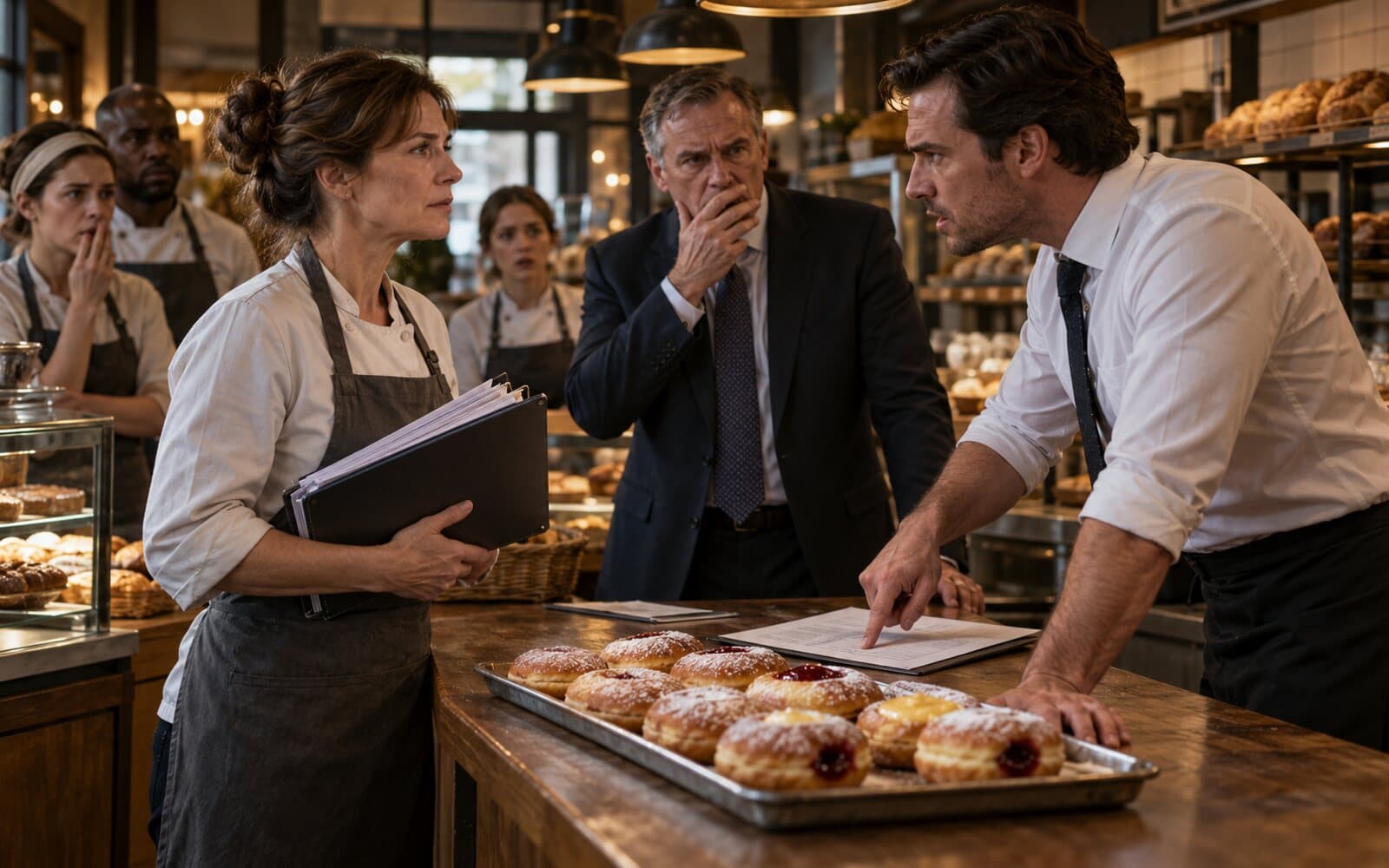
The next morning, two hundred doughnuts were due for collection at 8:30: 80 glazed, 60 jam-filled, and 60 custard-filled.
At 9:12, the bakery owner called me from Spain.
At 9:19, the regional manager arrived.
At 9:24, Darren found out that the production sheet he had been relying on had never been updated.
But by then, Elaine and her husband were standing at the counter with the wrong order in front of them.
The Work Behind the Counter
I had worked at Bellweather Bakery for six years. I began on the front counter, taking orders and learning which regulars wanted their coffee before they had finished opening the door. I learned who needed a receipt, who would ask for a paper bag even when carrying a box, and which parents had children who would only eat one particular filling.
After my first year, I started helping with morning preparation. By my third, new staff came to me when the display labels did not match the trays, when a collection had been entered twice, or when the filling delivery arrived without a usable date label.
I was never given a production title. Darren said the bakery did not need another title.
But from 5:30 each morning, I checked the delivery, logged the chilled fillings, matched the order book to the production sheet, and made sure the handover notes reflected what customers had actually asked for. When the morning shift was short, I covered the counter and helped the kitchen finish orders. When the evening staff were unsure which tray belonged to which collection, I showed them how to check the initials and times in the book.
I did it because the orders had to be right.
The Order Sheet
The Saturday party order had been taken on Tuesday by Maya, our weekend counter assistant. Elaine stood at the till with her phone open while Maya wrote in the customer order book.
“Eighty glazed, sixty jam, sixty custard,” Maya read back.
Elaine nodded. “That’s right. My daughter’s class is splitting the boxes. She knows which ones she wants.”
Maya wrote the quantities in blue ink, one line for each variety. I saw her do it because I was pricing a delivery beside her. Before Elaine left, Maya entered the same order into the bakery’s shared tablet and sent the confirmation.
On Wednesday morning, I checked it against the production sheet.
The customer confirmation listed 80 glazed, 60 jam, and 60 custard.
The production sheet listed 80 glazed and 120 jam.
I circled the line in red and wrote, Custard x 60 — check order book and customer confirmation. Then I took the sheet to Darren.
He glanced at it.
“Jam and custard are both filled,” he said. “It’s the same category.”
“They’re separate products.”
“They’re doughnuts, Ruth.”
“They’re separate lines on the order form. Elaine confirmed them separately.”
He picked up the pen and crossed out my note.
“We don’t need a committee every time someone orders doughnuts.”
The bakery was quiet enough that Maya stopped tapping at the till. Darren knew she had heard him. He turned the sheet over and put it beneath the clipboard.
I took the customer order book to the office and made a copy of the page. I saved the digital confirmation as a PDF and added both to the folder I had started the previous September.
The Record
That folder began with a missing tray of ring doughnuts. I had written down the order, the quantity on the sheet, the change Darren made, and the customer’s call when they arrived. At first, I kept the notes in a notebook. When the pages began to repeat, I made a spreadsheet.
By November, there were 14 entries.
By February, there were 31.
The spreadsheet had five columns: Date. Original order. Production sheet. Change. Outcome. Later, I added a sixth column for the person who had authorised the change. Darren had twice said he could not remember making one.
Each month had its own folder. Inside were the relevant order pages, screenshots of confirmations, and copies of handwritten production sheets. I used the same date format throughout so nothing could be misread. I saved the files to a second location because a record that could not be found at the moment it was needed was not a record anyone could rely on.
I did not start the folder to get Darren in trouble. I started it because customers kept asking why the order they had placed had become a different order by the time they arrived.
In April, Darren told me I was “creating paperwork for the sake of it.” I added that sentence to the notes. It was the first time he had described the problem as my record of it.
The Dismissal
On Thursday, I checked the Saturday order again. The customer confirmation still said 80 glazed, 60 jam, 60 custard. The production sheet still said 80 glazed, 120 jam.
I printed the confirmation and left it beside the sheet.
Darren picked it up and held it between two fingers.
“You’re still doing this?”
“I’m making sure the order matches.”
“It does.”
“It doesn’t.”
He folded the printout once and set it under the clipboard.
“I’ve changed the sheet.”
I looked at it. The jam line had been underlined. Nothing else had changed.
“Could you update the quantities in the tablet too?” I asked. “That way the counter, the kitchen, and the collection label all match.”
Darren put both hands on the counter.
“I am not having this conversation again.”
I wrote down the time. 2:17 p.m.
At 4:46, he put my badge on the counter and told me I was being dismissed for “undermining management decisions” and “making routine work unnecessarily difficult.”
He said I could collect my coat and leave my key beside the till.
I asked whether I should tell Maya about the Saturday order.
“No,” he said. “I know how to run a bakery.”
I left my key beside my badge. The badge faced up. I remember that because it seemed important that my name remained visible while he was explaining that I no longer had a place there.
At home, I opened the folder on my laptop.
The Saturday order was entry 47.
I checked the customer confirmation again. Eighty glazed. Sixty jam. Sixty custard.
Then I checked the production sheet’s version history. Darren had opened it at 2:13 p.m. on Thursday. He had not changed the quantities. At 2:19, he had added a note: Filled = filled. Use judgement.
I saved a screenshot and added it to the folder.
At 5:02, Maya messaged me.
Darren says you’re not coming in tomorrow. Is the party order okay?
I read it twice before answering.
The customer order is correct. Check the blue book and the confirmation in the tablet. The production sheet is wrong.
She sent a photograph of the production sheet. Darren had written 120 jam in the margin.
I forwarded the customer confirmation. Then I closed the folder. I had been dismissed, and Darren had said he knew how to run the bakery. I would not spend my first evening out of work completing the handover he had refused to let me give.
The Saturday Call
At 5:38, Darren called.
I let it ring twice before answering.
“Where’s the custard?” he asked.
“In the chilled unit.”
“No, it isn’t.”
“It was there when I left.”
“You were responsible for the fillings.”
“I logged the delivery at 6:11 this morning. Two sealed piping bags in the bottom drawer. The temperature was 3.8 degrees.”
The silence on the line changed. I could hear him moving through the kitchen.
“How do you remember that?”
“Because I wrote it down.”
A cupboard door shut.
“Fine,” Darren said. “I’ve found it.”
“Then the order is ready to be made.”
“Not if the sheet is wrong.”
“The customer confirmation is right.”
“I don’t need you to explain the tablet to me.”
“I’m telling you where the order is.”
He hung up.
At 6:12, Maya messaged again.
He says we’re doing 120 jam because that’s what the sheet says.
I typed a reply, deleted it, and typed another.
The customer ordered 60 jam and 60 custard. Please check with Elaine before substituting anything.
For fifty-four minutes, there was no reply.
At 7:06, Darren called again. This time I answered on the fourth ring.
“Elaine says the confirmation has custard on it.”
“Yes.”
“She says her daughter can’t eat jam.”
“Then it’s fortunate she ordered custard.”
“Don’t get clever with me.”
“I’m not.”
“She’s coming at half eight. I can’t remake the whole order now.”
“It’s 7:06.”
“We’ve got the morning service.”
“The custard is in the chilled unit. The doughnuts are not filled yet.”
He said nothing. In the background, I heard the metal rack wheels, the mixer, and Maya asking where the glaze trays were.
“I’ve already told the team what to do,” Darren said.
“Tell them the order changed.”
“It didn’t change. The sheet is the sheet.”
“The sheet is wrong.”
He ended the call.
At 8:30, Elaine arrived at Bellweather Bakery to collect the order. At 8:41, she sent me a message.
They have 80 glazed and 120 jam. Darren says he can’t do custard because the production sheet doesn’t list it.
The customer confirmation was in the tablet. The original page was in the blue book. The custard was in the fridge. Darren had a printed copy of the confirmation under his clipboard. Four separate records showed what Elaine had ordered.
At 8:47, I called the bakery.
Maya answered.
“Is Elaine still there?”
“She’s waiting. Her husband’s outside with the car.”
“Did you check the blue book?”
“It says sixty custard.”
“Then make the sixty custard.”
“Darren says he’s not authorising another batch.”
I heard him in the background.
“Tell her I’ll speak to the customer.”
A moment later, Darren was on the line.
“You’ve caused enough confusion,” he said.
“I didn’t change the sheet.”
“You made this a bigger issue than it needed to be.”
“I gave you the correct order on Thursday.”
“You’re not an employee here anymore. Don’t interfere with my staff.”
“Then stop calling me to ask where the custard is.”
The line went quiet.
For several seconds, neither of us spoke. I could hear someone move a tray across the counter. Then Darren said, “I’m calling the owner.”
At 9:12, Helen Ward called me from Spain. She had been away since Tuesday. I could hear the rolling wheels of a suitcase and an airport announcement behind her.
“Ruth, I need you to tell me exactly what was ordered.”
I opened the folder.
“Two hundred doughnuts. Eighty glazed, sixty jam, sixty custard. The confirmation went out Wednesday at 10:04. I flagged the production sheet Thursday at 2:17.”
“Did Darren see the confirmation?”
“Yes.”
“Are you certain?”
“I left a printed copy beside the sheet. He folded it and put it under the clipboard.”
I heard her stop walking.
“Do you have the copy?”
“Yes.”
“Send it to me. Send me everything.”
I sent the confirmation, the photograph of the production sheet, and the screenshot showing its version history. Then I sent the eleven-month discrepancy log.
Helen called back at 9:16.
“I’m looking at the production sheet,” she said. “Why does it say ‘filled is filled’?”
“Darren wrote that.”
“I can see that.”
“I was fired yesterday.”
“I know.”
“He told me not to contact the team.”
“I’m asking you what is happening.”
“Elaine has the wrong order. The custard is in the fridge. The kitchen can still make the right one if they start now.”
Helen drew a breath.
“Can you tell them that?”
“Darren told me not to interfere.”
The silence lasted long enough for me to look again at the folder on my desk. Forty-seven entries. The customer confirmation. The production sheet. The time I was dismissed.
“I’ll handle Darren,” Helen said. “Tell Maya the custard is in the lower fridge drawer, behind the cream trays. Don’t go in. Don’t do the work. Just tell her where it is.”
I sent Maya one message.
Helen has confirmed you can make the custard order. Lower fridge drawer, behind the cream trays. Use the blue book and customer confirmation.
At 9:19, a car stopped outside the bakery.
It was Martin Cole, the regional manager. He had been in the area for a supplier meeting. Helen had called him after she saw the version history.
Maya sent me a photograph through the front window. Martin stood beside the display case with his coat still on, holding the printed order sheet. Darren was behind the counter, pointing at the tablet. Elaine and her husband were still waiting.
At 9:24, Helen called again.
“They’ve found the order,” she said.
“They had it yesterday.”
“They’ve found the paper confirmation.”
“It was under the clipboard.”
“I know.”
She spoke slowly, as if each sentence had to be placed where it could not be moved.
“Martin says the production sheet was never updated.”
“That’s right.”
“He says the customer was given the correct confirmation.”
“That’s right.”
Another silence.
“I’m sorry, Ruth.”
I looked at entry 47 on my screen. It sat between the Thursday record and the Friday dismissal.
“I appreciate you saying that.”
“Can you come in and help finish the order?”
“No.”
The word was clear. It did not need a second sentence.
Helen did not argue.
“I understand,” she said. “They’ll manage.”
At 9:37, Maya messaged me.
Custard is in the fryer room. Martin is filling them. Darren is on the phone to Elaine.
At 9:51, the order was packed. Elaine collected it at 10:03, thirty-three minutes after the time written on her confirmation. The boxes were correct. Bellweather refunded her £12 and gave her a voucher for a dozen doughnuts.
Her daughter received the custard ones she had chosen.
On Monday, Helen asked me to come in for a meeting. I went because I wanted my final payslip corrected and my record to show that I had been dismissed, not that I had resigned.
Martin was there. Darren sat at the far end of the table with his arms folded.
Helen placed the blue order book on the table. Beside it, she set the printed confirmation and a copy of the production sheet.
“Ruth,” she said, “I want to understand why you kept these records.”
“Because the production sheet kept changing after the customer had confirmed the order.”
“Why didn’t you just tell Darren?”
“I did.”
Darren leaned forward.
“You made a personal issue out of normal bakery decisions.”
I opened the folder and turned to the first page.
“On the 12th of September, an order for forty-two mixed doughnuts was changed to forty-two jam. The customer called at 8:16 to ask why there were no glazed ones. On the 3rd of October, the Saturday collection was entered as Sunday. On the 19th of November—”
“I don’t need a recital,” Darren said.
“I do,” Martin said.
Darren sat back.
I went through the entries. Not all forty-seven. The ones that showed the same sequence: customer order confirmed, production sheet changed, no customer approval. Each entry had a date. Each had the relevant order. Each showed what I had raised and what happened after.
When I finished, Helen closed the folder.
“We’re changing the process,” she said. “The tablet confirmation will be the source order. Production sheets will be generated from it. Any substitution needs the customer’s agreement.”
“That would help,” I said.
“We will correct your employment record and pay the notice period.”
Darren looked at her.
“You’re doing all this over one order?”
“No,” Helen said. “I’m doing it because one order made the existing problem visible.”
Darren’s mouth tightened.
Helen slid a page across the table. It was a written apology. It said that I had raised a valid concern, that the production sheet had not been updated, and that dismissing me for raising it was not appropriate.
I read it once.
Then again.
I folded it and put it in my bag beside the copy of my final payslip.
Helen asked if I wanted my job back.
I looked at the blue order book. For six years, I had known which regular wanted the end seat, which child was allergic to sesame, and which collection orders needed a second count before the boxes were sealed.
“I don’t,” I said.
Darren looked down at the table.
Helen nodded.
The following Saturday, the new order process produced two copies: one for the counter and one for the kitchen. Both listed 80 glazed, 60 jam, and 60 custard.
Maya sent me a photograph. She had written MATCHED at the bottom in green marker.
I saved it beside entry 47.
The record was complete. The order had been written correctly, changed without permission, challenged in time, and restored to the exact quantities Elaine had confirmed. My name was no longer on the rota, but the procedure carried my correction forward.
For eleven months, I had recorded what happened when nobody checked.
Now there were two copies.
Topics