Transatlantic Journey Ends Poorly After Ice Risk Underestimated
A luxury crossing marketed as a triumph of confidence and engineering has prompted renewed scrutiny of route planning, lifeboat provision, and a series of public assurances that the vessel could not sink.
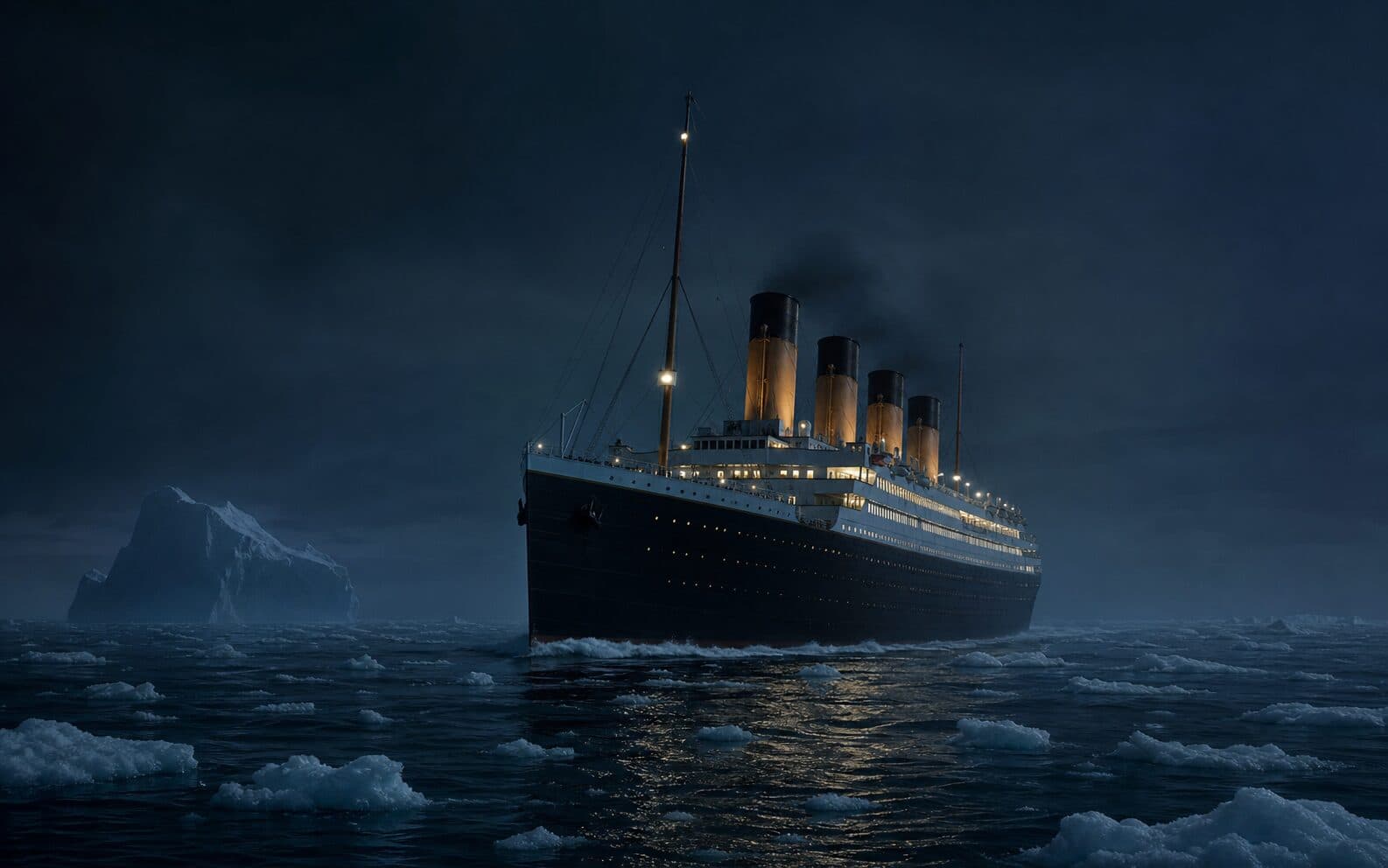
News Intro
A premium transatlantic crossing that operators had described as the most advanced and confident voyage ever attempted has ended in widespread disruption, after the vessel encountered an iceberg it had been travelling toward at speed.
The journey, which departed Southampton bound for New York, had been promoted less as a means of crossing the ocean and more as a public demonstration that modern engineering had moved beyond the possibility of failure. Officials repeatedly assured passengers, press, and one another that the ship was incapable of sinking.
That assurance is now the subject of intense review.
The vessel struck the iceberg during its first crossing, sustained damage along a significant portion of its hull below the waterline, and entered the water in full over the course of the following hours. Surviving passengers, recovered crew testimony, and a single widely circulated first-hand account have produced a picture of an operation that remained confident considerably longer than the evidence supported.
A voyage framed as a correction to doubt
From the outset, the crossing was presented as more than transport. Promotional material emphasised the scale of the dining rooms, the grandeur of the central staircase, and the unprecedented size of the vessel. The word "unsinkable" appeared in conversation so frequently that several passengers later said they had stopped treating it as a claim and begun treating it as a description of the weather.
Sources close to the operation confirm the ship was travelling at or near its highest speed at the time of the collision, in conditions where ice had been reported. Management has characterised this as ambition. Independent observers have characterised it as the central fact of the entire incident.
The decision to maintain speed has been defended on the grounds that arriving early would have generated favourable coverage. Coverage was generated.
A passenger manifest already under strain
Even before the collision, the voyage had drawn attention for reasons unrelated to navigation. A first-class passenger, engaged to a wealthy industrialist, had reportedly grown increasingly distressed with the expectations placed upon her and was, by several accounts, in a state of considerable personal crisis on the upper decks.
Separately, a third-class passenger had boarded at the last moment having won his ticket in a card game shortly before departure. Witnesses describe him as unusually content for someone who had acquired transatlantic passage through gambling minutes before the gangway was raised.
The two passengers became acquainted during the crossing, a development that attracted significant disapproval from the industrialist and his staff, and which would later be cited by some commentators as the only part of the voyage that went according to anyone's plan. A valuable diamond necklace also features prominently in surviving accounts, though its precise location remains a matter of ongoing public interest.
The newspaper notes that these are interpersonal matters and that the iceberg remained the operationally significant event.
The hours after contact
Once the collision had occurred, accounts describe a gradual transition from reassurance to organisation to difficulty. Passengers were initially advised there was no cause for alarm, an assessment that was technically accurate for a period measured in minutes rather than hours. As the situation developed, the shortfall in lifeboat capacity became the defining logistical problem of the night.
Witnesses report that the available boats were, in several instances, launched before they were full, a decision that has been variously attributed to caution, confusion, and an apparent reluctance to believe the vessel would actually require all of them. Surviving crew have confirmed that the ship's musicians continued performing for much of this period, a detail that recurs in almost every first-hand account and that survivors describe, without irony, as one of the more professional aspects of the evening.
The vessel ultimately separated into two sections before fully entering the water. The senior officer responsible for the crossing did not survive, and remained aboard in a manner that several commentators have described as broadly consistent with the conventions of the period and entirely consistent with the absence of a viable alternative.
The Passenger's Account
Notes from a crossing that began extremely well
I was actually there, which seems worth mentioning, given how many people now speak as though the entire voyage was obviously doomed from Southampton.
I boarded what I was told, repeatedly and by serious people in good uniforms, was the safest ship ever built. The staircase alone told you everything you needed to know. You do not build a staircase like that on a ship you have any doubts about.
The first few days were genuinely excellent. The dining was exceptional. The music was lovely. The general mood was one of total confidence, which I think reflects well on everyone involved.
Yes, at one point we made contact with an iceberg. I am trying to be balanced about this. These things happen, and the crew initially handled it with admirable calm. Nobody panicked, at least not at first, which I took as a very good sign about the overall quality of the vessel.
A few things I would gently note for anyone considering a similar trip:
- There were, on reflection, fewer lifeboats than passengers. I am told this was partly a design choice to keep the deck looking clean, which I do understand aesthetically.
- The water was extremely cold. I cannot stress this enough. The brochure did not prepare me for how cold.
- The band continued to play throughout, which I found reassuring and which I still think speaks to a real commitment to standards.
- At some stage the ship divided into two parts. I am not an engineer and I do not want to overstate this, but it did seem relevant.
I would also like to address the people asking about the gentleman I met during the crossing. We made a plan to stay together. The plan was sound. There was a floating piece of panelling involved and a great deal of discussion about it. I do not want to get into the buoyancy specifics in a public post.
As a voyage it exceeded expectations in some areas and failed in others. I survived, which complicates any simple rating system.
EDIT: Please stop asking whether I checked how fast we were going. I was a passenger.
EDIT 2: Yes, I am aware hindsight is now widely available. It was not available on the night.
EDIT 3: The phrase "floating monument to overconfidence" is being used about the ship and increasingly about me, and I do not think that is fair.
Maritime Review
The legal exposure here begins long before the iceberg. When an operator publicly and repeatedly asserts that a vessel cannot sink, it converts ordinary marketing into something far closer to a guarantee. Every subsequent decision — speed, route, lifeboat provision — is then measured against a standard the operator set for itself. The inquiry, in effect, was drafted at the press launch.
From a loss-adjustment standpoint, this is an almost textbook accumulation of avoidable factors. High speed through reported ice, insufficient lifeboat capacity, and a culture of certainty that discouraged contingency planning. Individually each is manageable. Together they are what the industry quietly refers to as a total loss with extra steps.
What interests me is the organisational psychology. You had a workforce and a passenger base who were all told, consistently and by people in authority, that failure was not possible. That belief does not simply prevent panic — it prevents preparation. When everyone has been assured nothing can go wrong, no one rehearses what to do when it does. Confidence had effectively been substituted for procedure.
Industry observers say the incident now stands as a leading case study in what happens when prestige messaging is allowed to occupy the space normally reserved for emergency planning.
Infrastructure Objection
What strikes me is the complete absence of any rail-based alternative for a journey of this importance. On a well-run network, a service of this profile would have multiple redundancies and a clear diversionary route. The North Atlantic offers neither. I have said for years that the abandonment of long- distance integrated transport planning leaves us exposed, and while I appreciate the iceberg is the headline, the deeper failure is one of connectivity.
The railway consultant declined to revise his position when it was pointed out that no rail crossing of the Atlantic exists.
Passenger Forum
u/Concerned_Rivets_88 · 48291 points · 6h ago
Any safety strategy that rests entirely on "trust us, look at the staircase" deserves extremely aggressive follow-up questions.
u/ActualPenguin34 · 31104 points · 6h ago
INFO: Who approved "unsinkable" as public-facing copy and were they on board.
u/MaidenVoyageRegret22 · 26770 points · 6h ago
The detail that gets me is that they kept the speed up to arrive early for the press. They got the press.
u/Buoyancy_Truther_01 · 22418 points · 6h ago
Genuine question and I am not trying to be cruel but was there room on the panel or not. People deserve to know.
u/Buoyancy_Truther_01 · 19980 points · 6h ago
Replying to myself because OP went quiet on the panel question. Telling.
u/Steerage_Steve_77 · 17655 points · 6h ago
Won his ticket in a card game and that turned out to be the second luckiest thing to happen to him that week and the unluckiest. Hard to process.
u/MildlyDamp_Toast · 14203 points · 6h ago
This is what happens when luxury branding is quietly asked to do the job of naval architecture.
Community Poll
Community Poll
Latest reader breakdown
Was the "unsinkable" messaging doing too much work?
Update
A representative for the operation has issued a statement acknowledging that the voyage did not conclude as intended.
We continue to review our route decisions, our speed in the relevant conditions, our lifeboat provision, and our external communications.
Several of our findings will be obvious.
Others will be obvious but expressed in nautical language.
We remain confident that lessons of some kind are available to be learned.
The surviving passenger from the online account has separately confirmed she has no plans to travel by sea again, describing future crossings as "something I will be doing extremely close to a flotation device, if at all." She added that she intends to live a long life and has, on reflection, decided against returning the necklace to anyone.
Topics