My Son Lost the Halloween Costume Prize to a Bedsheet. I Waited for the Judges to Explain Their Criteria.
A father questions a school costume award after the judges choose by applause, despite the programme promising Best Homemade Costume.
News Intro
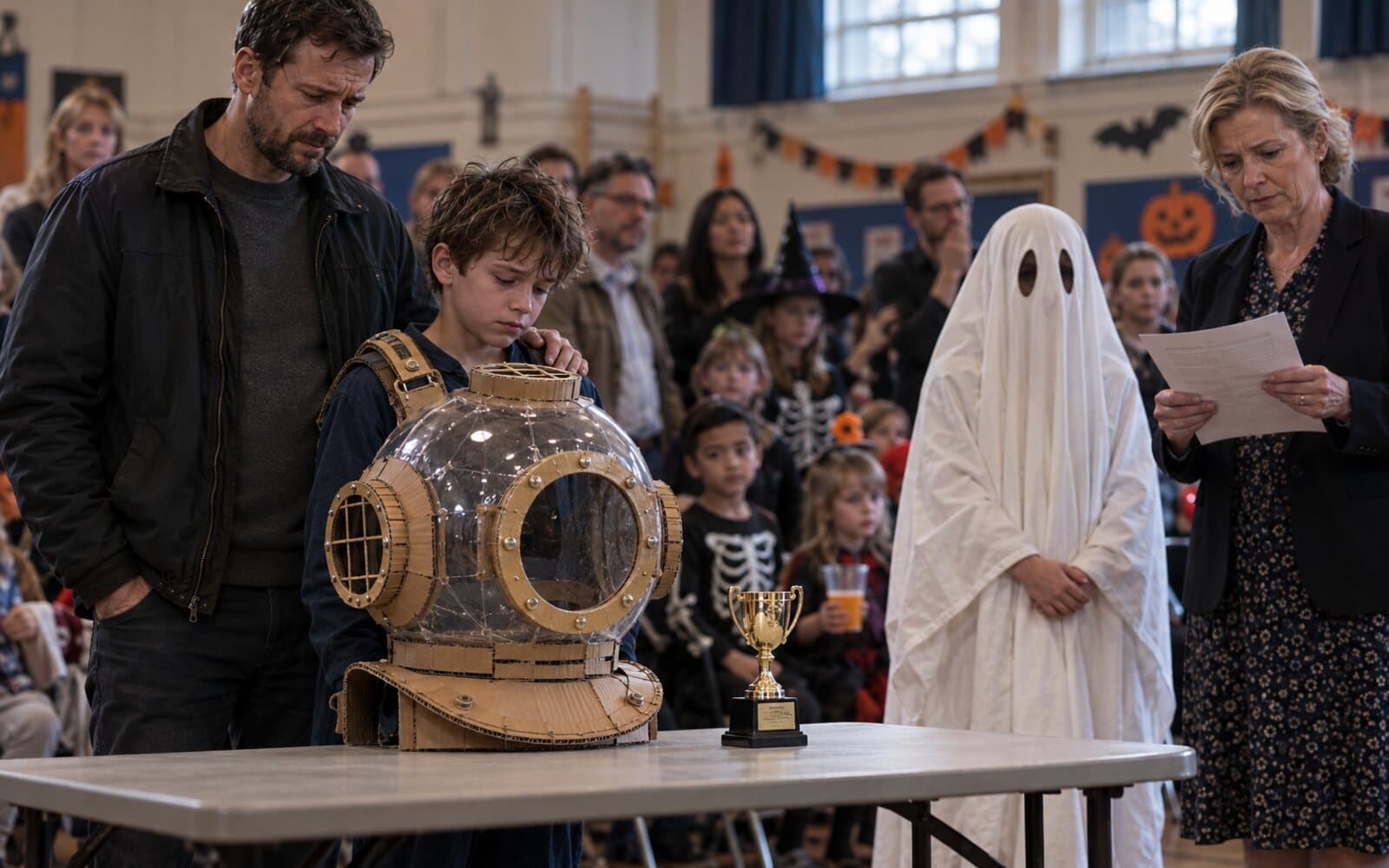
At 7:14 p.m. on Halloween, the head teacher said the winner had been chosen by applause.
The costume contest had been advertised as “Best Homemade Costume”.
My son’s six-week build had lost to a white bedsheet with two eyeholes.
The child wearing it stood beside the folding table with a paper cup of orange squash. He looked pleased, but he also looked cold. His mother was trying to keep the sheet from dragging through the puddles by holding one corner above his shoes. He had done nothing wrong, and I did not want a question about the award to become a question about him.
Owen stood beside me in his deep-sea diver costume. The helmet was made from a clear storage tub with a cardboard rim. The shoulder lamps were battery lights inside plastic cups. His mother had helped sew the straps, and I had spent three weekends getting the air hose to sit properly without catching on the coat hooks.
The judges had put the small brass trophy in front of the bedsheet.
“How did you decide?” I asked.
The head teacher looked at the printed programme. “The costume that got the most applause.”
“That is not what the category says.”
Behind her, parents were folding chairs. Someone was asking where the lost-property box had gone. The bedsheet child was eating a biscuit.
Owen was still standing beside me, holding the helmet under his arm.
“We’ll discuss it on Monday,” the head teacher said.
I nodded. “Yes. We will.”
The contest ended at 7:16. I recorded the time in the margin of the programme. The announcement and the discussion deferred until Monday were two separate events. I wanted that distinction preserved.
Six weeks
Owen had asked to enter the school’s Halloween contest on 18 September 2024. He was nine, with a November birthday. The school newsletter had said the event would include a costume parade and a prize for the Best Homemade Costume. There was no note about applause. There was no separate prize for children who came in character or who wore the costume they liked best.
“I want to be a deep-sea diver,” he said.
I asked if he meant a diver or a submarine pilot.
“A diver,” he said. “With a big helmet.”
We made a list of what we needed. A clear helmet, a dark suit, a hose, two lights, and somewhere to carry a small air tank. I did not write down measurements. I did not need a spreadsheet to know that a nine-year-old in a plastic helmet had to be able to see and walk.
The first tub was too narrow. The second fit over his head but moved when he turned. We padded the inside with foam and put a broad cardboard rim around the opening. The air hose was a length of grey pool tubing left over from a garden project. I shortened it so it reached his shoulder without dragging.
Owen chose the paint. He wanted the helmet to look “like it had been underwater.” We sponged on dark blue, then grey, then a little green around the edges. I thought the green was too bright. He said that was the point.
I let him decide.
The costume took six weeks because we worked on it after dinner and on Sunday afternoons. We cut cardboard at the kitchen table. Owen painted while I held the tube steady. When the first battery lights did not fit inside the cups, we bought smaller ones. The cups were fixed with soft ties so they could be removed without damaging the suit.
I did not make the costume for a prize. I made it because Owen wanted to enter and because he had asked me to help. But once the school printed a category, the words had a meaning. A homemade costume was not only a costume someone had put on. It was something a child and family had made.
I had read the line twice before we started. I had read it again the morning of the contest. I had not expected a scoring sheet or a panel of external assessors. I expected the phrase to mean what it said.
The programme
The programme was a single sheet of green paper. It listed the parade, the costume contest, a raffle, and the refreshments. At the bottom, in smaller type, it said: Judges will award the Best Homemade Costume at 7:00 p.m.
Owen read it at breakfast the week before.
“They’re judging the costumes,” he said.
“That’s what it says.”
“Do they know how long it takes to make one?”
“They can see what you made.”
He nodded and put the programme in his schoolbag. I did not tell him he would win. I did not tell him he should win. I said the costume was finished and that we would take it to school.
On the day, he put it on in the car park. The school had set up the hall with rows of chairs and a short runway marked with orange tape. Children were queuing beside the stage. A teacher had placed a cardboard box by the door for the raffle tickets.
The bedsheet child arrived with his mother at 6:28. He had cut the eyeholes unevenly, and the sheet sat low enough that his shoulders were hidden. He walked with both hands in front of him so he could see the floor. His mother kept a hand near his back without touching him.
“That’s a good ghost,” Owen said.
“It is,” I said.
The boy heard him and smiled beneath the sheet.
The costume parade began at 6:41. Each child walked from the side door to the stage and turned once. The judges were three adults: the head teacher, a parent volunteer, and the caretaker. They sat behind a table with a cup of tea, a clipboard, and the trophy.
The children were not scored in public. The judges spoke quietly after the last child had walked. Owen’s helmet fogged for a moment. He wiped it with his sleeve. The lights remained on.
Then the head teacher stood up.
The announcement
“Thank you to everyone who took part,” she said. “You all looked fantastic. We’ve chosen the winner based on the costume that received the biggest reaction from the audience.”
She paused for the applause.
“The winner is our ghost!”
The bedsheet child came forward. His mother lifted the trailing corner so he would not trip. The head teacher handed him the trophy. Everyone clapped. Owen clapped too.
The head teacher had not said “best homemade costume”. She had said “biggest reaction”. There was no mention of how it was made, what materials had been used, or what the child had done himself.
I waited until the families had moved away from the stage.
“Can I ask about the category?” I said to the head teacher.
“Of course.”
“The programme says Best Homemade Costume. You said the winner was chosen by applause.”
“We thought it was a fair way to choose.”
“Fair to which category?”
She looked at me. “The children enjoyed it.”
“I’m not asking whether they enjoyed it. I’m asking what was judged.”
The parent volunteer gathered the programmes into a pile. The caretaker picked up an empty cup from the floor.
“We didn’t have a scoring system,” the head teacher said. “The judges talked it through.”
“Then how did you distinguish a homemade costume from a sheet?”
The child’s mother was still helping him hold the trophy. She heard the question and looked over. I lowered my voice.
“This isn’t about him,” I said. “He looks happy. I’m asking about the award.”
“I understand,” the head teacher said. “We can talk Monday.”
I agreed. It was not the time to continue. Owen had taken off the helmet and was carrying it by the rim. His cheeks were flushed from the warm hall.
“Did they judge the costumes?” he asked.
“They judged the reaction.”
“Oh.”
He looked at the ghost, who was being photographed beside the stage. “He did get a lot of claps.”
“He did.”
“Can we get chips?”
We went to the car.
Monday
On Monday, I met the head teacher after pickup. Owen was at football practice. I had brought the programme with me, not as evidence, but because it was the only written description of the award.
The head teacher said the staff had thought “homemade” meant a costume assembled at home, rather than a costume judged on its construction.
“Then every costume was homemade,” I said.
“Most of them.”
“That cannot have been the criterion.”
She folded her hands on the desk. “We didn’t want to make the children feel that some costumes were better than others.”
“You gave a trophy to one child. That already made them different.”
She considered this. “We wanted the event to be fun.”
“It was fun. Owen had a good time. The question is what the award recognised.”
She glanced at the programme. “We could have explained it better.”
“You could have named it differently.”
She did not answer immediately. She tapped the corner of the green paper twice, then stopped.
“What would you have called it?” she asked.
“Audience favourite.”
She wrote that down.
I told her the school did not need to take the trophy away. The child had won it under the rule the judges had actually used. The problem was the name of the prize. If it had been called audience favourite, the result would have made sense. If it was Best Homemade Costume, the school should judge the making.
“Would you like to send a suggestion for next year?” she asked.
“I can do that.”
I sent one sentence the next morning: If the winner is chosen by applause, could the programme call it Audience Favourite? I did not propose a panel, a scoring rubric, or an appeals process. The award had already taken more of my attention than I had planned to give it.
The head teacher replied, Thanks. We can change that wording.
There was no meeting. On Friday, the school office sent a reminder about the Christmas fair and asked parents to return lost water bottles. The reply about the costume contest sat underneath it in my inbox.
I printed it anyway. It was not a formal decision. It was a written acknowledgment that the name of an award should describe the way it was decided. I placed it behind the programme in the folder where I keep school correspondence.
The ghost child had won the trophy fairly under the method the adults used. I had never asked for it to be taken away. The point was that the printed name and the spoken method had not matched, and that the mismatch had been noticed.
The next contest
In October 2025, the school sent home a new programme. It listed one costume award: Audience Favourite, chosen by applause.
Owen did not enter the contest. He was ten and in Year 6 at the same primary school. He read the programme when it came home in his book bag and handed it back to me.
“They changed it,” he said.
“They did.”
“Because of last year?”
“Because I asked what they meant.”
He nodded once. “That’s fair.”
He did not say the trophy should have been his. He did not ask what the ghost had done with it. He put his schoolbag on the chair and went upstairs.
I went to the event because I had helped Owen enter the year before. The hall had the same orange tape and the same folding table. The new programme lay beside the trophy, and the award name was printed in larger type than it had been in 2024.
The judges asked each child to turn once beneath the stage lights. They did not announce a score or rank the children. At the end, the children clapped for the pirate. The head teacher named the award exactly as it appeared on the programme. Nobody discussed how long any costume had taken to make.
The bedsheet child watched the pirate receive the trophy and clapped along with the other children. His mother lifted the hem clear of the floor as they left the hall. He seemed pleased to have come back. He did not ask about the trophy.
Owen asked me later who had won. I told him. He said, “Good,” and went back to the game he was playing.
I did not regard the wording change as a correction to the result. A later programme could not alter what had been announced in 2024. It did, however, carry the distinction from one page to the next. A label can occupy one line on a programme and still be the only explanation a child receives for an adult decision. I considered the change a meaningful outcome.
Owen’s helmet is in the loft now. The lights still work. The hose is in a box with the cardboard rim, wrapped in a carrier bag so dust does not collect inside it. I have not thrown it away.
The trophy went home with the pirate. The programme named the award correctly.
For the school, it was one line in an annual notice. I kept the 2024 programme and the head teacher’s reply together. They document the point at which the words on the page began to match the decision in the hall. I have no reason to expect anyone else to keep them. I kept them because someone had to retain the sequence accurately.
Topics