My Sister-in-Law Said Nobody Wanted My Bonfire Night Potatoes. At 7:12, My Father Asked Where They Were.
A Bonfire Night family expects jacket potatoes alongside the pizza. The narrator treats Jo’s brief thumbs-up as a historic written concession.
News Intro
At 7:12 p.m. on Bonfire Night, Dad asked where the jacket potatoes were.
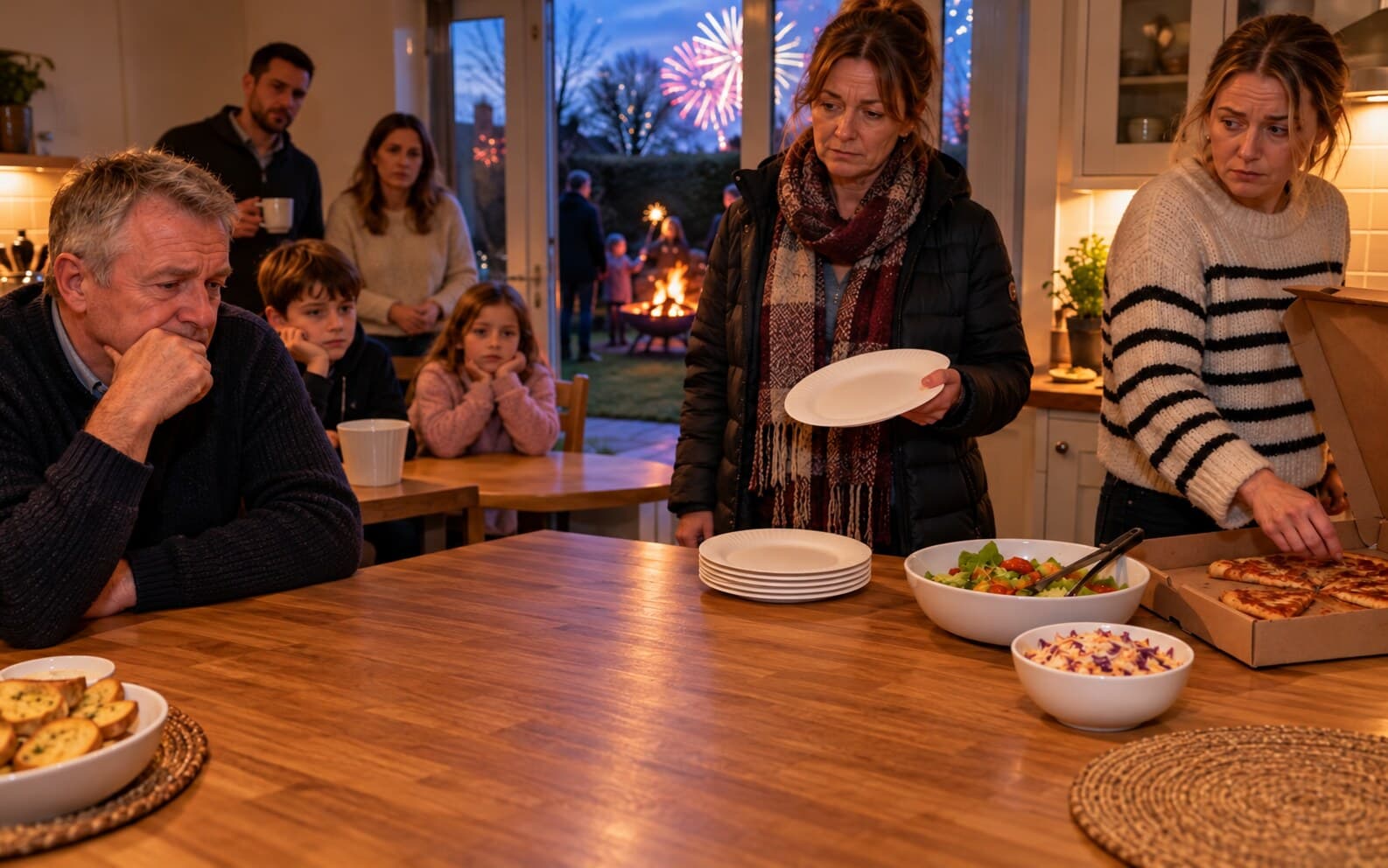
I was standing beside the kitchen door with a paper plate in my hand. My sister-in-law Jo was opening a pizza box. The children were waiting for the next part of the garden display, and the table had been set for food that did not include potatoes.
“There aren’t any,” I said.
Dad looked at me. “You didn’t bring them?”
“Jo said nobody wanted them.”
Jo stopped with the pizza box open.
“I said we’d ordered pizza,” she said.
“You said not to bring the potatoes.”
“I said we didn’t need them.”
The distinction was not difficult to hear.
For fifteen years, I had brought foil-wrapped jacket potatoes to the family’s Bonfire Night gathering. In 2022, I had been told not to bring them because pizza had been ordered.
Dad looked at the boxes on the table.
“I thought there’d be potatoes as well,” he said.
There were no potatoes.
The arrangement
Our Bonfire Night gathering began in 2007, when my parents moved to a house with a long back garden and a covered patio. My brother Owen had two young children, and our parents wanted them to see a few sparklers before the weather got too cold. The adults brought chairs. My mother made tea. I brought a tray of jacket potatoes because I had been asked to bring something warm.
The potatoes were easy to carry and easy to share. I baked them at home, wrapped each one in foil, and put them in an insulated carrier. At the gathering, people took one when they were ready. We usually served them after the first fireworks, when the children came in to warm their hands. There was no recipe to argue about and no special topping. We had butter, salt, and a small bowl of grated cheese.
The next year, my mother asked if I could bring them again. I did.
In 2009, Dad said the potatoes had stayed warm longer than he expected. In 2010, my niece was old enough to have one without help. By 2011, we had started setting the carrier on a small table beside the kitchen door.
I did not regard it as a family institution. It was a practical way to make sure there was something hot to eat while people came in and out of the garden. The gathering had fireworks, drinks, and food. I took care of one part of that arrangement.
Over the years, I learned how many potatoes to prepare. In 2014, there were eleven people. I brought twelve. In 2017, two neighbours joined us, so I brought sixteen. In 2019, we had seventeen people and I brought eighteen. There was always one extra in case someone arrived late.
I did not record the numbers. I remembered them because I had been doing the same thing for years. If someone said they were no longer hungry, I left their potato in the carrier. If someone wanted half, I found a knife. If a child wanted butter but no cheese, I gave them a spoon and let them do it themselves.
It was not complicated.
That was why, when Jo told me the potatoes were not needed, I did not ask her to explain. I thought she was telling me the plan had changed. I did not want to bring food that had no place on the table.
Jo’s plan
Jo married my brother Owen in 2018. She was organised and liked to plan meals ahead. She brought a printed menu to family gatherings and asked people to confirm what they would eat. I appreciated the effort. It meant there was less waste and fewer last-minute trips to the shop.
In 2020, she added pizzas to the Bonfire Night menu. The first year, the delivery arrived early, and we kept the boxes closed until everyone was ready. In 2021, the driver called from the end of the road and Owen went to meet him. The pizzas were hot when they arrived.
On 18 October 2022, Jo sent a message to the family group.
We’re doing pizza this year. Please let me know how many slices people want.
I replied that I would bring the potatoes as usual.
She answered: Don’t bother with the potatoes. Nobody needs both. I’ve got the food covered.
I read the message twice. I did not argue with her. She was hosting, and she had ordered food. I answered, Understood. I won’t bring them.
I did not prepare a carrier. I did not buy potatoes. I did not bring the butter and cheese. There was no reason to make food after the host had said it was unnecessary.
Dad did not reply to the group message. He was not comfortable with the family chat and usually read it without answering. I assumed Owen would tell him about the pizzas.
On the afternoon of 5 November, I rang Dad to ask if he needed a lift. He said Owen was picking him up. I did not mention the potatoes. The plan had been settled.
At 4:52, Jo sent the delivery time: Pizza should be here by 6:45. We’ll eat before the next display.
I read it. I arrived at 5:31 with a box of paper napkins. I had not brought food. I had been asked not to.
The table
At 5:44, Jo put three paper plates on the table. At 6:09, Owen brought out the drinks. At 6:27, the children went into the garden with their parents. At 6:43, the pizza delivery had not arrived.
Jo called the shop. The driver said he was on his way. She set out the plates and moved a chair so the children could get past the table.
“Are the potatoes still coming?” Dad asked me.
“No.”
He looked at the kitchen door. “Why not?”
“Jo ordered pizza.”
“But you always bring the potatoes.”
“Jo said not to.”
He nodded. He did not ask me to go home and get them. He did not complain about Jo. He went outside to see if the children were ready.
The pizza arrived at 6:58. Owen brought the boxes inside and put them on the table. They were labelled by type, and Jo opened them one at a time. The children chose slices. Some of the adults waited until the next display had finished.
At 7:12, Dad asked again.
“Where are the jacket potatoes?”
“There aren’t any.”
“I thought you were bringing them.”
“Jo said nobody wanted them.”
Jo looked up from the pizza box. “I said we had pizza.”
“You said not to bring the potatoes.”
“Because there was no point having both.”
Dad looked at the table. There were four pizzas, two boxes open, and a stack of napkins beside them.
“I thought we were having both,” he said.
No one answered him. Owen took a slice of cheese pizza and moved aside so his daughter could reach the table.
I put my paper plate down.
What “covered” meant
Jo closed the pizza box. “We have enough food.”
Dad looked at the table. “I thought the potatoes came after the first display.”
Jo turned toward him. “I thought you meant potatoes with the pizza.”
“I thought we were having both.”
“I ordered enough pizza for everyone.”
No one had told Dad the potatoes were no longer part of the evening. I had not told him either. I had read Jo’s message, understood that she did not want me to bring them, and assumed the rest of the family had seen the same plan.
Jo looked at me. “I said I had the food covered.”
“You did.”
“I thought you meant you wouldn’t bring them.”
“I understood that. I didn’t know Dad still expected them after the display.”
She looked from me to him. “I don’t want two meals happening at once.”
“They never did,” I said. “The potatoes came out after the children were cold.”
Jo rested one hand on the closed pizza box. “I thought they were part of dinner.”
The difference was in the order, not the food. Pizza arrived before the display. The potatoes had always been served after it. Jo had ordered for the first part of the evening and I had been responsible for the second. We had been discussing the same table as if it had one moment.
“The meal has a sequence,” I said. “The menu does not end when the boxes arrive.”
Jo did not answer. Dad took a slice of pizza. He folded it once and put it on his plate. He was not angry. He had wanted to know where the potatoes were, and now he knew why they were absent.
I had not brought them because I had been told not to. That was the decision I had honoured. It did not make the evening’s order correct.
The rest of the evening
The children went back outside after eating. The next display was short. Owen carried the leftover pizza boxes to the recycling. Jo wiped the table. My mother asked if anyone wanted tea.
Nothing else was said about the potatoes.
That was the part I kept returning to. There was no confrontation that settled it. There was no public vote on what people preferred. There was only the sentence Jo had sent and the question Dad had asked.
At 8:16, I asked Dad if he wanted a lift home. He said Owen was taking him. He thanked Jo for hosting. He thanked me for bringing napkins.
He did not mention the potatoes again.
The next morning, Owen called to ask whether I was annoyed.
“I was asked not to bring them.”
“Jo thought the pizza was enough.”
“She can order whatever she wants.”
“Dad said he thought there’d be potatoes.”
“He wasn’t asked.”
Owen was quiet for a few seconds. “I should have told him.”
“Yes.”
He said he would speak to Dad. I did not ask him to. The meal was over. A conversation after the fact could not make the table contain something it had not contained.
The next day, Dad called me to ask if I had the phone number for the garden centre. He wanted to ask about a rose bush. He did not mention Bonfire Night. I did not bring it up.
The following year
In October 2023, Jo sent another message about Bonfire Night. She was hosting again and had ordered pizza.
I’ve got the food covered.
I read the sentence, then called Dad.
“Do you want potatoes this year?” I asked.
“Are you making them?”
“I can.”
“Then yes.”
I replied to Jo: Dad would like the potatoes. I’ll bring them.
She answered with a thumbs-up.
At the gathering, I carried in the insulated case. There were seventeen people, so I had brought eighteen potatoes. Dad took one when he arrived at the table. He put butter on it and sat down beside the back door.
Jo put a stack of plates beside the pizza boxes. She did not announce the potatoes. They arrived, and there was room for them.
The thumbs-up was a small blue icon. It appeared directly beneath my message and did not contain a sentence, a qualification, or a request to reconsider. I read it as confirmation that the potatoes were included in the evening’s plan.
For fifteen years, I had brought the potatoes because they belonged to the evening. In 2022, the plan had removed them before the evening began. In 2023, the message included Dad’s answer before the menu was settled.
I saved the exchange in the family chat. A thumbs-up is not a policy document. It was, however, the first written confirmation that the potatoes had a place on the table before I baked them.
The next morning, I washed the insulated case and put it back in the cupboard. The potatoes had been served after the first display. The pizza had been served before it. The order had been understood, and the message remained in the thread.
Topics