I Bought Twenty Sparklers for Bonfire Night. My Wife Handed Them Out Without Asking Me. One Guest Got Three.
Daniel buys twenty sparklers for Bonfire Night, but his wife hands them out before the guest list arrives. One neighbour receives three.
News Intro
At 6:54 p.m. on 5 November 2024, Sarah handed me the last sparkler.
“Here,” she said. “You sort it out.”
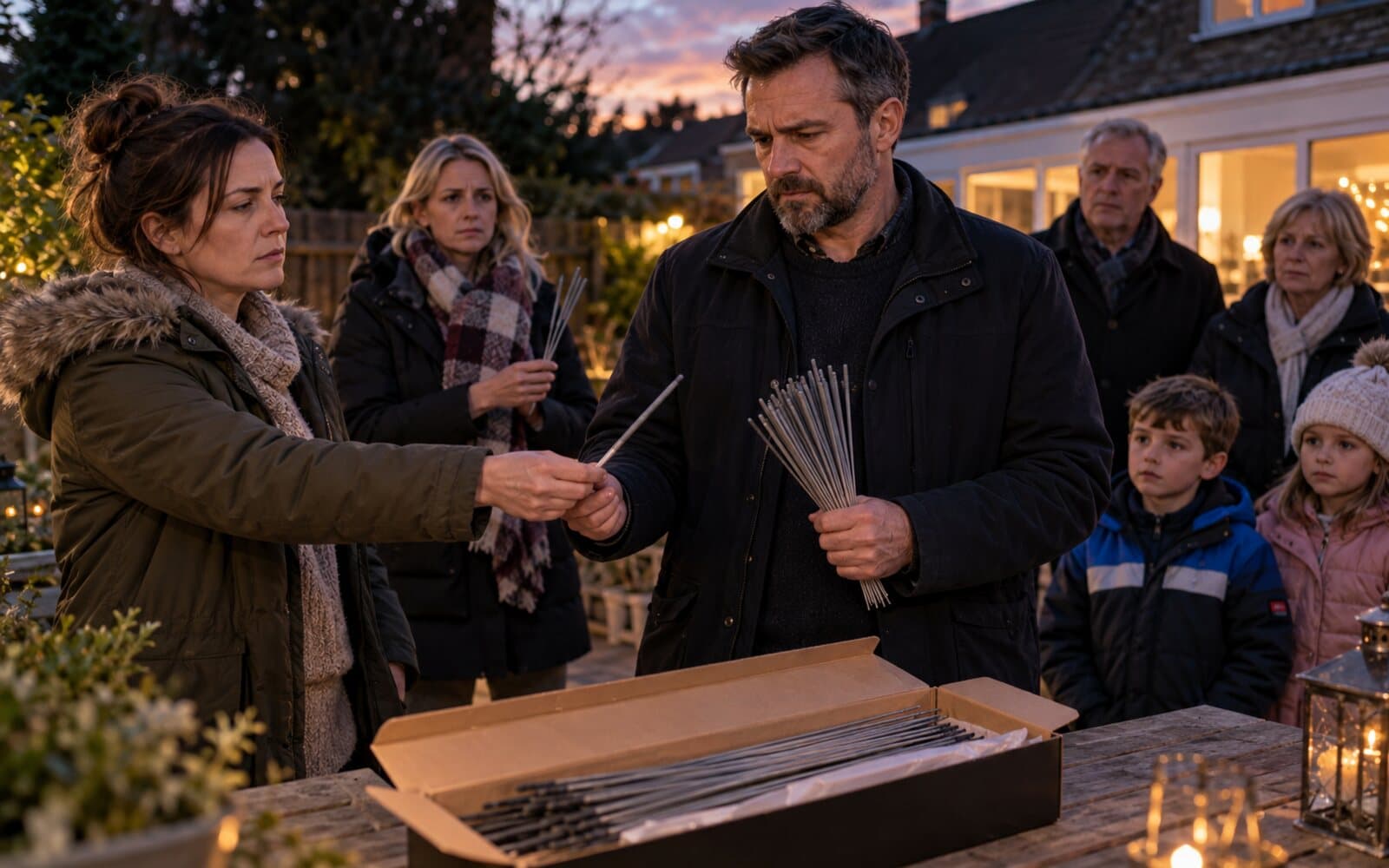
I looked at the open box. There had been twenty sparklers in it when I bought them. There were now three people waiting, one sparkler in Sarah’s hand, and one guest holding three.
“Who has three?” I asked.
Sarah pointed toward the far end of the patio.
Mr Collins was standing beside the garden wall with one sparkler in each hand and a third tucked through the top of his coat pocket.
“He asked for an extra,” Sarah said.
“I said one per person.”
“He said one had a bent end and he wanted a spare.”
“They haven’t been lit yet.”
She looked toward the group. “It’s fine, Daniel.”
The children were waiting by the garden gate. My mother had arrived late. The box was on the table, its cardboard lid folded back.
“It isn’t a question of whether there are enough,” I said.
Sarah put the last sparkler into my hand. “Then you decide.”
I had bought twenty. I had planned for sixteen guests, including the adults supervising the children, one for myself, and three spares.
The distribution had begun without me.
The number
For years, Sarah and I had attended Bonfire Night gatherings where sparklers were passed around in whatever order people happened to be standing. Someone always had one before someone else. Someone always reached into the box twice. No one knew how many remained until the box was empty.
I did not like that.
In 2017, one of our nieces had arrived just as the adults were dividing them up. There had been two left. Her brother had one, and their cousin had three. The niece said she did not mind. I knew she minded because she stopped asking for one.
I gave her mine.
I thought about it the next day. If there were enough for everyone, the order should be clear. If there were not enough, the adults should know before handing out more than one to anyone. That was not a difficult principle.
In 2018, I bought a box of twenty. There were fourteen people at the gathering. I handed one to each person who wanted one and kept six aside. We used four. The last two went back in the box.
Sarah said it had worked well.
“It’s easier when one person hands them out,” she said.
I agreed.
The next year, I bought the same number. In 2020, we did not hold a gathering. In 2021, we met outside at my sister’s house, and I brought sparklers again. There were seventeen people. I handed them out one at a time and kept three spares for anyone who arrived late.
It was not a complicated system. It was a count.
In 2022, Sarah handed out the sparklers. She had done it without asking me. I did not say anything because there were twelve people, and she had given each person one. There had been no issue.
That year had not changed the arrangement. I had bought the sparklers. I had checked the count. We had been in my sister’s garden. Sarah had simply been standing nearest the box.
I understood that. I did not object to sharing the work. I objected to changing the allocation without knowing what it was.
The gathering
In 2024, we hosted at our house. Sarah had invited her parents, my mother, her brother, and two neighbouring families. Sixteen guests confirmed. I bought twenty sparklers on the afternoon of 4 November.
I counted them when I got home.
There were twenty.
I put the box on the high shelf in the utility room, away from the food and the things the children might pick up while they were playing. On the day, I brought it outside and set it on the patio table beside the drinks.
The children were not to handle them until the adults had organised the group. We followed the package directions and kept them in the clear area in the garden. There was no reason to rush. People had been talking inside for most of an hour.
At 6:31, Sarah brought out the first tray of food. At 6:39, my mother called to say the taxi was outside her building. At 6:42, Sarah put the coats over the chairs. At 6:47, the children asked whether they could have their sparklers.
“When your grandmother gets here,” I said.
“She’s nearly here,” Sarah said.
The box remained on the table. The lid was folded back, and the twenty sparklers were visible. I had lined them up in two groups of ten so the count could be seen. I had not done that to make a point. It was simply easier to check the number that way.
Sarah came outside with a cup of tea. She looked at the children, then at the box.
“Shall I give them out?”
“Wait until Mum gets here.”
“They’ve been asking for ten minutes.”
“She’ll be here in a minute.”
“I can give her one when she arrives.”
I did not answer. I was carrying two chairs from the kitchen.
At 6:51, my mother walked through the gate. She was wearing a blue wool coat and carrying a small bag. I went to meet her. Sarah stayed by the table with the children.
I had not asked her to hand them out.
The distribution
When I returned, the box was open and several sparklers were gone.
Sarah had handed them out. She was at the end of the table, asking who still needed one. Fourteen of the sixteen guests had received at least one. Thirteen had one each; Mr Collins had three. My mother and a neighbour’s daughter were the two guests still waiting. I had not taken mine either. There were three people waiting for a first sparkler, counting me as host.
I looked at the box. There were three left. Sarah already had hers beside her cup and was holding the fourth unassigned sparkler for me. The other sixteen had been handed out: thirteen guests had one each, Mr Collins had three.
“How many did you give him?” I asked.
“Two. He said one had a bent end.”
“The bent one is still in the box.”
Mr Collins looked at the sparkler in his pocket. “I thought I’d have a spare.”
“There are three people without one.”
“I only need one,” he said. He removed two sparklers from his hands and held them out to Sarah.
She put the two returned sparklers into the box. “There. Sorted.”
There were now five in the box and one still in Sarah’s hand for me. My mother and the neighbour’s daughter were the two guests without one. I had not taken mine. Six sparklers for three people, leaving three in the box once the handout was complete.
It was not sorted. It was one correction to one part of the distribution. My mother had arrived. The neighbour’s daughter was still inside. There were now five sparklers in the box, and Sarah was holding the sixth.
“Who has had two?” I asked.
Sarah looked around. “I don’t know.”
“Then we need to check.”
She put the sparkler down. “You can check if you want.”
“I do want.”
The children had begun looking at one another’s sparklers. One boy asked if he could trade his for a different one. His father told him they were all the same. Mr Collins had returned the two extras and kept one. He went to help his wife bring out a plate.
Nobody was upset. Nobody was missing a meal. The group was waiting for me to decide how the remaining sparklers should be handed out.
I counted the people who had one. Then I counted the sparklers left in the box. Sarah handed me the one she had been holding. I took it for myself, gave one to my mother, and asked the neighbour’s daughter, who had now come outside, if she wanted one. She said she wanted to hold it with her father. Her father took one for her. Three people received one each. Three remained.
The numbers worked.
That did not settle the matter.
The instruction
“You should have asked me first,” I said to Sarah.
She looked at the box. “You were bringing Mum through the gate.”
“I had already said to wait.”
“I thought you meant wait for Mum to arrive.”
“She had arrived.”
“And I started handing them out.”
“Without checking who had one.”
She lowered her voice. “No one was upset.”
“That is not the measure.”
She stopped. Her hand rested on the table beside the box.
“What is the measure, then?”
“Whether the distribution was even.”
“There are spares.”
“There were three people without one and one person with three.”
“He gave one back.”
“After I asked.”
Sarah looked across the garden. “Are we doing this now?”
I considered the children waiting and the adults moving around the table. “We can finish handing them out. Then we can talk.”
“You’ve got the last one,” she said. “You sort it out.”
She was not agreeing that I was right. She was asking me to take over.
I took the sparkler from her hand.
“One each,” I said.
No one objected. My mother took hers. The neighbour’s daughter received one from her father. I took mine. The three sparklers left in the box stayed there.
The people still waiting each received one. Three sparklers remained in the box. No one received three. No one was left without one.
I did not consider the matter closed.
The second conversation
The children began to move toward the clear area. An adult checked that everyone was in place. The first sparklers were lit in accordance with the instructions. I stood beside my mother while she held hers. Sarah stood near her brother.
The light lasted a few minutes. It was a pleasant part of the evening. When the sparklers went out, people put the used wires in the tin and returned to the house.
At 7:19, I found Sarah beside the kitchen sink.
“You were upset,” she said.
“I was concerned about how you gave them out.”
“They were sparklers, Daniel.”
“They were twenty sparklers for fourteen people.”
“And everyone had one.”
“Because I counted the ones left.”
She dried her hands. “You wanted to hand them out.”
“I had planned to.”
“You could have said that.”
“I did. I said to wait.”
“I thought you meant until your mother came.”
I had no answer to that. She had interpreted my words differently from what I intended. But she had taken over the distribution without asking whether I was ready.
“Next year,” I said, “I’ll hand them out.”
She nodded. “All right.”
She took the empty serving plate to the table. I put the box of sparklers back on the high shelf.
The next morning, I checked the box. There were three unused sparklers inside, exactly as there had been when I closed it. I put them in the drawer with the matches rather than leaving them on the patio table, where they could be mistaken for part of the next gathering’s supply.
Sarah was making tea. “You were right about the count,” she said.
“The count was right before anyone opened the box.”
She looked at me over the kettle. “I mean there were enough.”
“There were enough because I had allowed for late arrivals and spares.”
She set two cups on the counter. “I know.”
That was the first time she had said it plainly. I did not ask her to repeat it or explain why she had handed them out before my mother arrived. We had already discussed that. The issue was not whether the box contained enough metal sticks to last a few minutes. It was whether someone could change the order after I had made it clear that I was managing the distribution.
I wrote “three remaining” on the cardboard sleeve with a pencil and put it away. I did not need to preserve the number for a later argument. I needed it so I would know what was in the drawer when I bought the next box.
Sarah took her tea into the living room. The conversation ended there. There was no apology, and I did not require one. She had acknowledged the count. The following year, she would ask before handing anything out.
One year later
In 2025, we hosted again. I bought twenty sparklers. There were sixteen guests, including Sarah; I was the host. I counted the box when I brought it home and put it on the shelf.
At 6:51, I brought it outside. There were sixteen guests, including Sarah; fifteen were present and the neighbour’s daughter was late. I set one aside for myself and one for her. The other fifteen guests each received one. That accounted for seventeen sparklers, leaving three in the box.
When she arrived, I handed her the reserved sparkler. There were still three in the box. Mr Collins stood beside his wife with one in his hand. He looked at the box, then at me, and did not ask for another.
Sarah carried the drinks outside. The children lit their sparklers with the adults beside them. I closed the box and put it on the table.
I wrote the date on the empty cardboard sleeve and placed it in the drawer beside the matches.
Topics